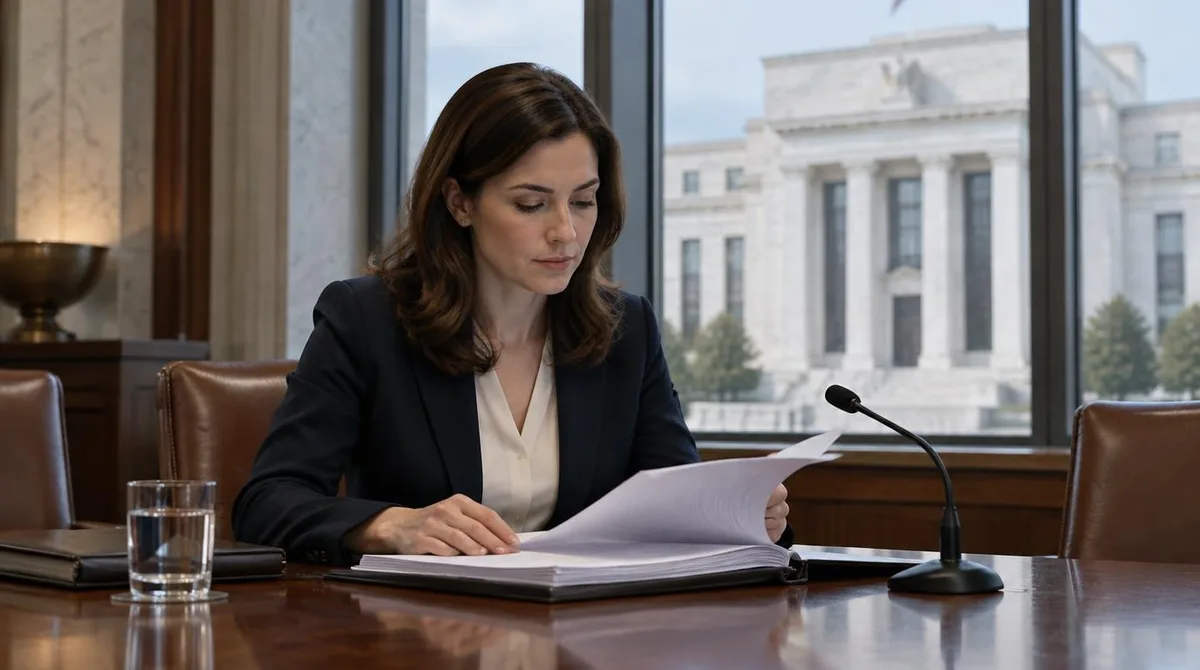
The FOMC is the Federal Open Market Committee, the twelve-member panel within the Federal Reserve System that sets the stance of United States monetary policy. It holds eight regularly scheduled meetings per year, as the Federal Reserve states on its committee page. Each meeting is a review of economic and financial conditions, and each one ends in a decision about policy. Understanding that cycle is the fastest way to read the rate headlines.
Rate days draw the most attention. The fed rate decision explained reference walks through what moves on those days. The committee behind those decisions has a fixed shape, and that shape rarely changes.
Committee coverage sits inside the wider flow of markets and policy news. The investing news hub collects the site's running reference pages on that beat. The committee's calendar sets the rhythm of the policy year.
What Is FOMC: The Short Answer
The letters stand for the Federal Open Market Committee. Wikipedia's reference describes it as the body charged under United States law with overseeing the nation's open market operations, the buying and selling of Treasury securities. In practice the committee sets the short-term objective for those operations. That objective is usually a target level for the federal funds rate, the rate banks charge one another for overnight loans. The committee also directs Federal Reserve operations in foreign exchange markets. Any intervention there is coordinated with the Treasury. The Treasury holds responsibility for the dollar's exchange value.
Who Sits on the Committee
Twelve members hold votes. Seven are the members of the Board of Governors. One seat always belongs to the president of the Federal Reserve Bank of New York. Four more seats rotate among the other eleven Reserve Bank presidents, and those terms last one year. The Fed sorts the banks into four blocs for this rotation. One bloc pairs Boston, Philadelphia, and Richmond. Another pairs Minneapolis, Kansas City, and San Francisco. Every regional bank gets a turn on a schedule the Fed fixes in advance. The roster also names alternate members for the rotating seats. The Board's chair serves as chair of the committee. The Fed's committee page lists Kevin Warsh in that role for 2026. That pairing is old. Wikipedia notes the Board's chair has led the committee without a break since 1935.
How a Meeting Year Runs
The calendar holds eight regularly scheduled meetings. At each one, the committee reviews economic and financial conditions. It determines the appropriate stance of monetary policy. It also weighs the risks to its long-run goals of price stability and sustainable growth. The other Reserve Bank presidents attend as well. They do not all vote, yet they join the discussions and contribute to the committee's assessment of the economy and its policy options. Membership changes arrive at the first scheduled meeting of each year, which resets the rotation on a known date. For related coverage, see What Moved the 10-Year Treasury Yield in May 2026.
Where the Committee Came From
The structure arrived in steps. Reserve banks once bought and sold in the open market on their own. At times they bid against each other. An informal committee formed in 1922 to coordinate those purchases and sales. The Banking Act of 1933 created an official FOMC. The Banking Act of 1935 revised the design to include the Board of Governors. An amendment in 1942 settled the current structure of twelve voting members.
Conclusion: Twelve Votes on a Fixed Calendar
The FOMC is a fixed framework around a moving target. Twelve voters meet eight times a year around one working objective, the federal funds rate. The rotation of seats spreads the vote across the regional banks, while the New York Fed holds a permanent place beside the Board. Meetings follow the same documented cycle of review, decision, and risk assessment. That rhythm is why policy news arrives on schedule.