
A short squeeze is a rapid rise in a stock's price that forces traders who bet against that stock to buy it back, which pushes the price higher still. The cycle is mechanical, not mysterious: losses on the short side create buying, and that buying creates more losses. It depends on individual circumstances whether any given squeeze matters to a portfolio, but understanding the mechanism explains some of the sharpest moves markets produce.
The mechanism starts with short selling. In stock-market usage, to go short means to sell a security you do not own, expecting to buy it back later at a lower price. The Cambridge Dictionary's business English entry records this usage directly, defining "go short" as selling in anticipation of a fall, and gives the example of speculators going short on a currency; it also notes constructions like "as many as 27% of the company's shares have been shorted" as ordinary market language (Cambridge Dictionary). A short seller borrows shares, sells them, and owes the lender the shares back at some point. The debt is denominated in shares, not money. That single detail drives everything that follows.
What makes a squeeze violent is the asymmetry of the position. A buyer's maximum loss is capped: the stock can only fall to zero. A short seller's loss is uncapped, because a stock can rise without a known ceiling. As the price climbs, the short seller faces a choice with a deadline built into it. Buy back now and lock in the loss, or wait and risk a worse price. When enough shorts face that choice at once, their buying arrives together, and the price rises faster than any fundamental news could move it.
How does short selling actually work?
Short selling is a four-step loan wrapped around a trade. First, the short seller borrows shares from a holder, usually through a broker who locates shares from its own inventory, from margin clients, or from large institutional lenders. Second, the seller sells those borrowed shares on the open market and receives cash. Third, the position sits open. The seller owes the lender the shares, plus any dividends the stock pays while the loan is out, plus a borrow fee. Fourth, the seller closes the trade by buying shares in the market and returning them to the lender.
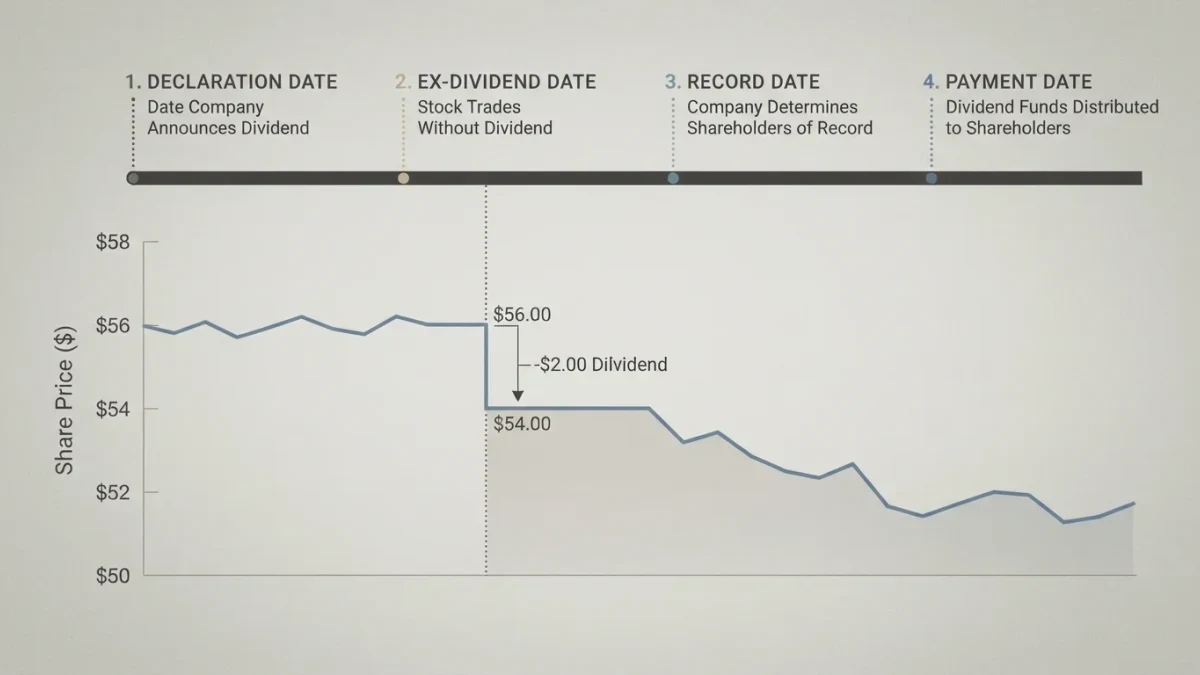
Two costs accumulate while the position is open, and both matter to squeeze dynamics. The borrow fee can spike when shares become scarce, which is itself a signal that short demand is crowding. Dividend obligations are passed to the short, so a short seller holding through a payout loses cash on the date the dividend goes ex — the mechanics are covered in How Dividend Ex-Dates Affect Stock Returns. A crowded, expensive, dividend-paying short is a position under pressure before the price moves at all.
What turns short interest into a squeeze?
Short interest measures how much of a stock's available shares are sold short. High short interest means many market participants owe shares back and will eventually need to buy. High short interest alone does not cause a squeeze. The trigger is usually a price move upward, often on unexpected news, that starts forcing the weakest short positions to close.
What this means for reading the tape: the sequence matters more than the level. A stock with heavy short interest that trades quietly has balanced risk. The same stock that gaps upward on news creates a feedback loop. Early closing buys lift the price. The lift triggers margin calls — demands from brokers that shorts post more collateral or close. Forced closing creates more buying. Because each seller's obligation is fixed in shares, every closing buyer adds demand regardless of price. There is no natural seller on the other side of the trade the way there is in a normal decline, where buyers step in at lower valuations. The result is a move that can overshoot any reasonable estimate of value in both directions, first up in the squeeze and often down sharply after it ends.
Why do squeezes end as fast as they start?
A squeeze ends when the forced buying runs out. Shorts who could close have closed. Shorts who remain are those able and willing to post more collateral, and their incentive now is to hold rather than add fuel. Once the mechanical buyer disappears, the stock trades on the same fundamentals it always had. If those fundamentals never supported the elevated price, the reversal can be as abrupt as the squeeze.
The aftermath is the part most commentary skips. A squeeze is a transfer of losses from shorts to late buyers, not a change in what the company earns. Traders who buy during the squeeze because the price is rising are buying from parties who are legally required to sell — an orderly exit for the shorts, and a poor entry for anyone who mistakes forced buying for durable demand. Our analysis of the mechanism is that the squeeze itself carries no information about the business; it is information about position structure.
What can a long-term investor take from squeeze dynamics?
Several practical observations follow from the mechanics, none of which amount to a trading instruction.
- Short interest is a risk marker, not a verdict. A heavily shorted stock reflects many investors expressing a negative view. That view can be right, wrong, or crowded. The number itself does not say which.
- Volatility cuts both ways. A stock with crowded short positions can move violently in either direction on little news. Long-term holders who would not buy at the squeeze price should not treat the squeeze as validation of the lower price they liked either; the price discovery during these episodes is distorted.
- Margin is the amplifier. Squeezes are margin events. The same leverage dynamics that force short covering appear on the long side in market declines, which is one reason margin debt levels are worth watching across the market — see What FINRA Margin Debt Data Show for May 2026.
- Headline moves deserve a mechanism check. Before treating any violent move as news about a company, ask whether position structure — short interest, borrow costs, index flows — could explain it. A routine for filtering this kind of noise is set out in How to Build a Personal Investing News Routine That Filters Noise.
Position structure also explains moves outside equities. Leveraged and heavily shorted positioning exists in crypto markets too, and the same reflex — forced closing of losing positions cascading into more forced closing — produces violent moves there, including liquidation cascades in perpetual futures. The asset differs; the liability structure does not. Readers following that market can find related coverage in the site's crypto section.
The limits of squeeze analysis
Two limitations follow. First, public short-interest data is reported on a lag and can be stale by the time a squeeze is underway, so it describes positioning as it was, not as it is. Second, the evidence on squeezes establishes the mechanism — forced buying from uncapped-loss positions amplifies upward moves — but it does not establish a reliable way to predict which crowded short will squeeze or when. Attempts to trade squeezes directly are speculation on timing, not investing, and the record of late buyers in past episodes is not encouraging.
What the mechanism does give a long-term investor is a filter. Violent price moves are not always information about value. Sometimes they are information about who owed what to whom, and when the debt came due. Knowing that distinction is most of the practical value a squeeze explanation can offer.