
A dividend is a distribution of a company's profits to its shareholders, paid per share and not guaranteed to continue. Whether an investor actually receives an announced payout comes down to four dates: the declaration date, the ex-dividend date, the record date and the payment date. Missing the ex-dividend date is the most common mistake, because buying shares after it means buying the stock without the dividend attached.
The sequence matters more than the announcement itself. According to Fidelity, the process starts after a company's board of directors decides to pay a dividend, and only then sets the deadlines and shares the information with the market. A payout that has been declared can still be cut or cancelled, so a declaration is a commitment with conditions, not a promise.
This article walks through each date in order, explains who qualifies for payment, and covers how dividends are paid and taxed. For a closer look at how the ex-date specifically moves share prices, see How Dividend Ex-Dates Affect Stock Returns.
What are the four dividend dates, in order?
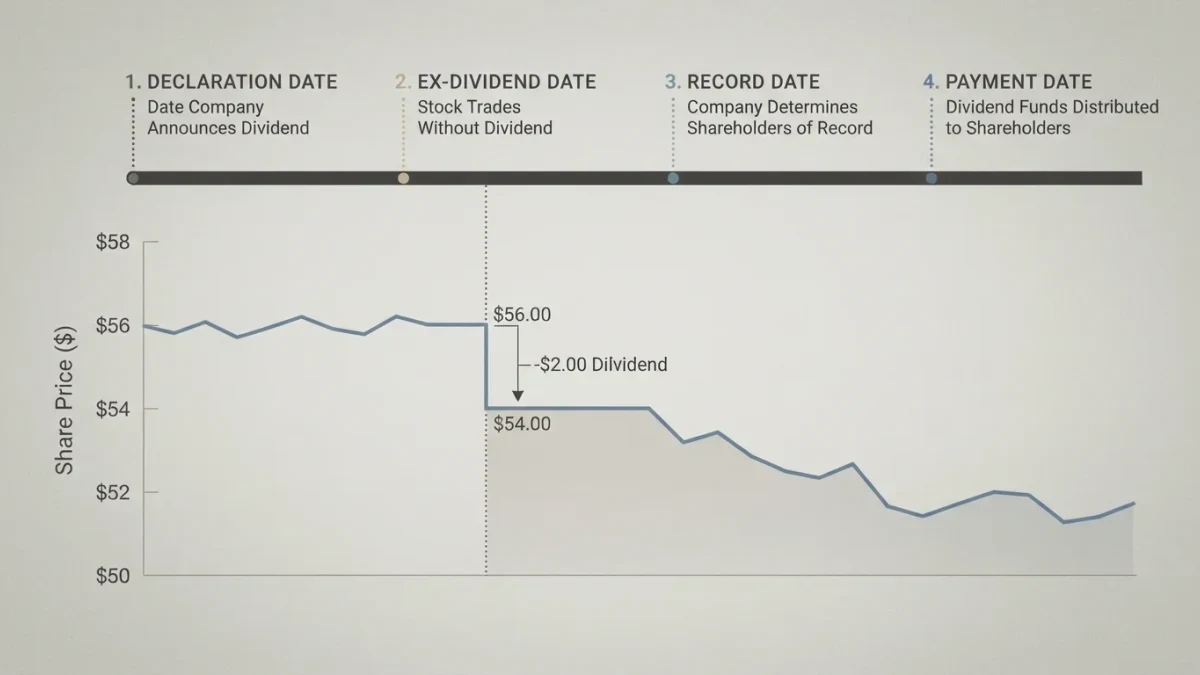
The four dates run in a fixed sequence, and each one does a different job.
- Declaration date. The company announces the dividend, its amount per share, and the dates that follow. This is the day the payout becomes public.
- Ex-dividend date. The date the stock begins trading without the upcoming dividend. Investors who buy on or after this date will not receive the declared payment, as Fidelity's explainer states plainly.
- Record date. The date on which the company determines which shareholders are entitled to receive the dividend.
- Payment date. The date the dividend is actually distributed to eligible shareholders.
The ex-dividend date is the one that changes behaviour. Ownership on the record date decides payment, but settlement takes time, so the ex-date is set slightly earlier to give trades time to settle. Buy before the ex-date and the dividend is yours even if you sell before the record date. Buy on or after it, and the seller keeps the payment.
One practical consequence: a stock's price typically adjusts downward on the ex-dividend date by roughly the amount of the payout, because new buyers are no longer purchasing the right to receive it. That adjustment is why chasing a dividend by buying on the announcement rarely produces free money.
Who qualifies for the payment?
Qualification is mechanical, not discretionary. The company checks its shareholder register on the record date. Anyone who held shares before the ex-dividend date, and still held them through settlement, is on that list.
Different share classes change the picture. Preferred stockholders have priority: a company must pay dividends on its preferred shares before distributing income to common shareholders, and preferred payments tend to be fixed amounts rather than fluctuating with earnings, as Wikipedia's dividend entry and Fidelity both describe. Preferred dividends are still not guaranteed in the way bond coupons are, but they sit ahead of common dividends in the queue.
Dividends are allocated as a fixed amount per share, so payouts scale with shareholding. Someone holding 100 shares with a 50-cent-per-share dividend receives $50. That arithmetic comes straight from the sourced material, and it is the whole calculation: no negotiation, no pro-rating for when in the quarter you bought.
How are dividends paid, and in what form?
Cash is the normal form, usually deposited into a brokerage account or mailed as a check. Three alternatives exist, and each changes what the shareholder actually receives.
- Cash dividends. The most common form, paid by electronic funds transfer or paper check. The money can be withdrawn, reinvested, or directed elsewhere.
- Dividend reinvestment plans (DRIPs). The dividend automatically buys additional shares, or fractional shares when the amount falls short of a full share.
- Stock dividends. The investor receives additional shares instead of cash, typically in proportion to shares owned. A 5% stock dividend on 100 shares yields 5 extra shares. Stock dividends do not change the company's market capitalization; the share count rises and the price per share falls.
Rarer forms include property dividends, paid in assets such as securities of other companies, and special dividends, which are one-time payments tied to a particular event or unusually high earnings. Special dividends do not follow a set schedule and may come from companies that pay no regular dividend at all.
How does dividend taxation work?
Dividends held in taxable brokerage accounts are generally taxed in the year they are paid, not the year they were declared. Reinvested dividends are taxed too: the IRS generally treats DRIP purchases as taxable income even though no cash reached the investor. Dividends in tax-advantaged retirement accounts generally are not taxed when paid.
When dividends are taxed, the rate depends on their classification. Ordinary dividends are taxed at the investor's ordinary income tax rate. Qualified dividends are taxed at capital gains rates, which are typically lower. Fidelity's guide specifies the holding requirements: for common shares, at least 61 days within a 121-day period starting 60 days before the ex-dividend date, without hedging the position. Preferred shares carry their own variants of the same test, with longer windows for dividends attributable to periods of more than 366 days.
The holding-period rule creates a trap worth naming. Buying just before the ex-date and selling just after can capture the dividend but disqualify it from qualified treatment, pushing the income into a higher tax bracket. The dates that decide payment and the dates that decide tax treatment are not the same dates.
What are the risks income investors should weigh?
The central risk is simple: dividends are not guaranteed. A company may cut the dividend amount, reduce its frequency, or cancel payments altogether at any time. Public companies usually pay on a fixed schedule, most commonly quarterly, but the schedule is a habit, not an obligation.
Two structural points deserve attention. First, the payout is a trade-off. When a company pays dividends, it has less to reinvest in its own business, which is why companies typically shift to paying dividends as their growth rates decline. A dividend is a signal about where a business is in its lifecycle, not a bonus on top of growth. Second, dividend income is only one input. As Fidelity notes, investors should evaluate a company's financial strength and returns potential as a whole, since some non-dividend-paying stocks outperform some dividend payers and the reverse.
Historical context supports the durability of the mechanism without promising anything about the future. The Dutch East India Company was the first recorded public company to pay regular dividends, distributing annual payments worth around 18% of share value across nearly two centuries of existence, from 1602 to 1800, per the sourced historical record. The machinery is old and well tested. The specific payouts are not.
Practical steps: reading a dividend announcement
When a dividend announcement crosses the newswire, four checks turn it from noise into information.
- Confirm the four dates. If the announcement omits the ex-dividend or record date, the payout is not yet fully specified.
- Note the amount per share and compare it with prior quarters to see whether it was raised, held, or cut.
- Check the payment form: cash, DRIP-eligible, or stock.
- If taxes matter, note the ex-date and work out whether a realistic holding window would satisfy the qualified-dividend period before any purchase decision.
For readers tracking announcements as part of a broader routine, the same discipline applies as anywhere else in market news: read the dates, not the sentiment. A structured approach to filtering announcements is set out in How to Build a Personal Investing News Routine That Filters Noise. Readers following this should also see How to Build a Personal Investing News Routine That Filters Noise.
What the evidence establishes, and what it does not
The sourced material establishes the mechanics cleanly. Four dates govern every payout. The ex-dividend date, not the record date, is the deadline that decides who buys the right to payment. Preferred shareholders are paid before common ones. Cash, reinvestment and stock are the standard forms. Taxation follows payment, with holding-period tests deciding the rate.
What the evidence does not establish is anything about future payouts, future dividend growth, or how any specific company will behave. Those questions depend on each company's earnings, board decisions and circumstances, and no schedule or history guarantees them. The dates are the reliable part. The money is not.