
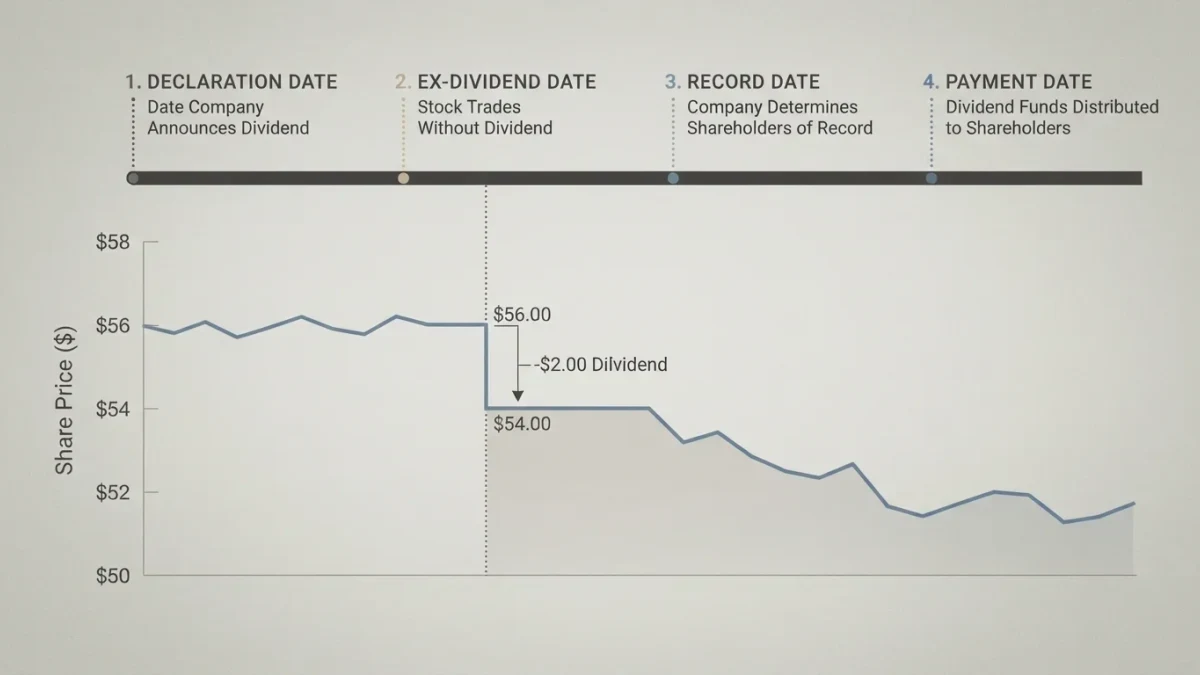
The ex-dividend date is the first day a stock trades without the right to its next declared dividend: buyers on or after that date do not receive the payment, and the share price opens lower by roughly the dividend amount — on average less, per Elton and Gruber's 1970 study.
This explainer covers dividend-date mechanics and their documented return effects; tax outcomes depend on individual circumstances this site cannot know.
What are the four dividend dates?
Every regular dividend runs on the same schedule of four dates. The declaration date is when the board announces the amount and the calendar. The ex-dividend date sets entitlement. The record date is when the company checks its books for eligible holders. The payment date is when cash is distributed.
A simplified timeline illustrates the sequence:
| Date | Event | Who is affected |
|---|---|---|
| Declaration date | Board announces dividend | All holders and watchers |
| Ex-dividend date | Stock trades without the dividend | Buyers from this day forward |
| Record date | Company records eligible holders | Holders who bought before ex-date |
| Payment date | Cash is paid | Eligible holders of record |
The table is illustrative: exact spacing between the dates varies by company and market, and the gaps are set in each announcement rather than by a universal rule.
What happened to the ex-date under T+1 settlement?
The ex-date is tied to settlement, not to the calendar. When U.S. markets moved to next-day settlement on May 28, 2024, under the SEC's T+1 rule, the practical consequence was that the ex-dividend date and the record date now typically fall on the same day: buying on the record date no longer settles in time to appear on the company's books, so entitlement must already have attached the day before.
Before that change, under T+2 settlement, the ex-date sat one business day before the record date. Readers comparing older dividend references with current ones will see that one-day shift, and the SEC's investor guidance reflects the updated convention.
What happens to the share price on the ex-date?
On the ex-date morning, the exchange reduces the opening reference price by the dividend amount. The logic is arithmetic: the company is about to transfer cash out, so the business is worth less by that amount, and the quote adjusts to keep the ex-date from creating a fictitious gap in the price series.
Empirically, prices do not always drop by exactly the dividend. A foundational study by Elton and Gruber, published in the Review of Economics and Statistics in 1970, found that stocks on average fell by less than the full dividend on their ex-dates, a pattern the authors attributed to taxes — holders in higher tax brackets preferred the capital gain and priced the dividend accordingly. The finding launched a drop-off literature that continues to document deviations in both directions.
How do ex-dates change measured returns?
The ex-date is where price return and total return diverge. A price-only series treats the ex-date step-down as a negative return and never credits the cash. A total-return series assumes the dividend is reinvested on the payment date, so the cash compounds. Across decades, that difference accumulates: total-return figures for dividend-paying indexes substantially exceed their price-only counterparts, and the entire gap originates in payments that cross an ex-date.
Two practical implications follow. Index selection matters when comparing performance: a price index and a total-return index of the same market answer different questions. And distribution timing affects short-horizon measurement — a holding period that begins just after an ex-date misses the payment that a period begun a day earlier would include, with no change in the underlying business.
How do funds handle dividends and ex-dates?
Funds intermediate the same mechanics. An accumulating fund or an index total-return series retains the cash internally and reinvests it, so the fund's net asset value does not step down on underlying ex-dates in the way a single stock's price does. A distributing fund passes payments through to shareholders on its own schedule — typically quarterly or annually — with its own ex-date for fund shares. Dividend reinvestment plans, or DRIPs, apply the same logic at the account level, converting the cash into fractional shares at or near the payment date.
The distinction matters when comparing products. Two funds holding identical portfolios can report different return profiles purely because one distributes and the other accumulates. Neither outcome is better in general — the choice interacts with taxes and cash needs, which depend on individual circumstances — but the return figures answer different questions, and the difference traces back to how each handles dividends crossing their ex-dates.
Can investors trade around ex-dates?
The obvious idea — buy the day before the ex-date, collect the dividend, sell after — is known as dividend capture, and the mechanics above explain why it is not free money. The price step-down offsets the cash received, trading costs cut into both legs, and in taxable accounts the dividend is often taxed as income in the year received while the offsetting price loss may realize at a different time or character.
Documented analyses of capture strategies in the practitioner and academic literature generally find that returns after costs and taxes fail to beat simply holding, and the pattern is consistent with the arithmetic: a mechanical price adjustment leaves nothing to capture before frictions. Presenting the strategy here is educational, not an endorsement or a warning about any specific position.
What should readers take from dividend-date mechanics?
Three durable points. Entitlement is determined by holding before the ex-date — nothing else on the calendar matters for who gets paid. The ex-date price adjustment is a measurement convention, not a loss or a gain in itself. And return comparisons should name their basis: price-only series systematically understate what a reinvesting holder experienced, by exactly the dividends that crossed an ex-date.
A numeric example shows the split. A stock closes at 100 dollars the day before its ex-date for a 2 dollar dividend. On the ex-date the reference price opens near 98 dollars. A price-only calculation records a 2 percent decline; a holder who kept the shares has lost nothing in economic terms, because 98 dollars of stock plus 2 dollars of pending cash equals the prior 100. If the stock pays a similar dividend every quarter, the price series accrues roughly eight points of manufactured losses a year that total return adds back.