
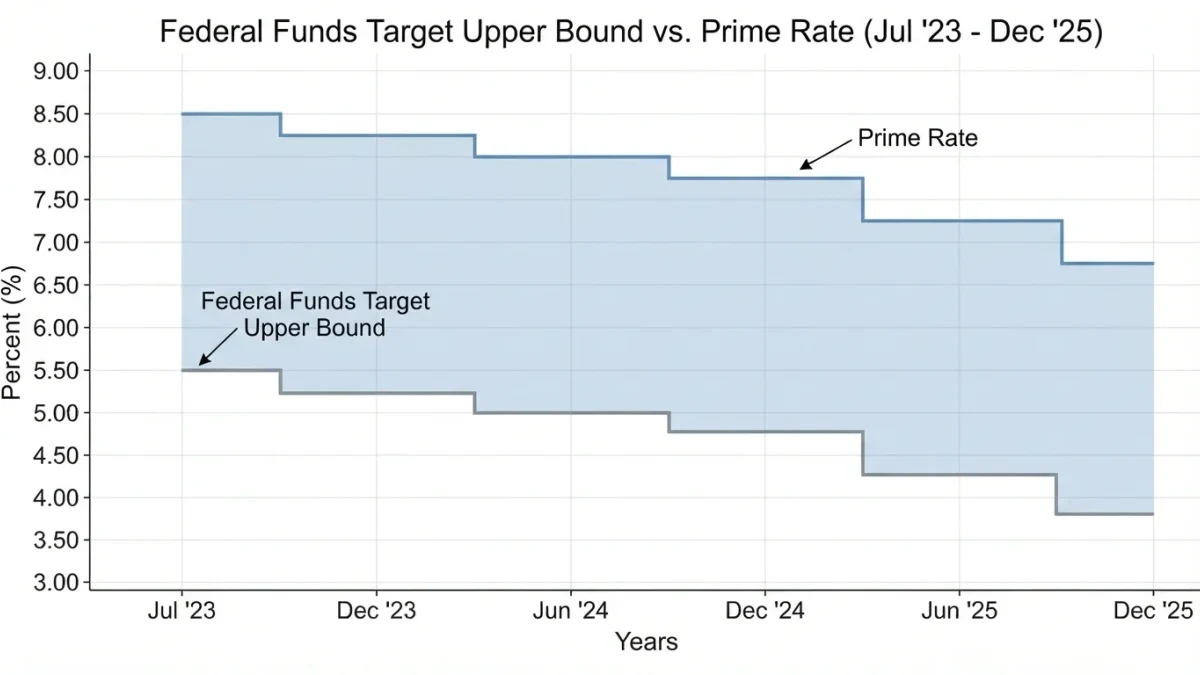
The prime rate is the base interest rate commercial banks post for their most creditworthy corporate borrowers, while the fed funds rate is the Fed's overnight lending target. They move in lockstep: with the target range at 3.50 to 3.75 percent since December 11, 2025, the posted prime rate stands at 6.75 percent, per Wall Street Journal data.
Horison publishes information, not investment advice. Benchmark rates describe financing costs already set by banks and the central bank; they cannot indicate whether any borrowing or investing decision suits an individual reader.
What is the federal funds rate?
The federal funds rate is the interest rate at which banks lend reserve balances to one another overnight. The Federal Open Market Committee (FOMC) does not set this market rate directly; it announces a target range and uses administered rates — interest on reserve balances and an overnight reverse repurchase facility — to keep the effective rate inside that range.
Per Federal Reserve policy records, three quarter-point cuts effective September 18, October 30, and December 11, 2025 brought the target range from 4.25 to 4.50 percent down to 3.50 to 3.75 percent, where it remained after the January 28, 2026 meeting. The target range is the anchor for dollar short-term rates, from money market yields to floating-rate contracts.
The range format itself has a history. The FOMC expressed its objective as a single point rate for most of the period after it began announcing targets in the mid-1990s and switched to a range in December 2008, the format still used. Either way, the transmission to posted bank benchmarks runs through the top of the range.
What is the prime rate, and who sets it?
Each bank posts its own prime rate, a reference for loans to its strongest business customers. The figure widely quoted as the prime rate is the Wall Street Journal prime, defined as the base rate on corporate loans posted by at least 70 percent of the 10 largest U.S. banks. When major banks change their posted rate, the Journal benchmark moves with them.
Major lenders, including Bank of America and JPMorgan Chase, posted 6.75 percent effective December 11, 2025, per their published rate histories. The prime rate peaked at 8.50 percent in July 2023 and last changed on December 11, 2025.
How does the fed funds rate transmit to the prime rate?
The transmission is a convention, not a regulation: for decades, large banks have set prime at three percentage points above the top of the fed funds target range. The pattern held through the entire 2023 to 2025 cycle, as the table below shows using documented rate histories.
| Date effective | Fed funds target range | Posted prime rate |
|---|---|---|
| July 27, 2023 | 5.25 to 5.50 percent | 8.50 percent |
| December 19, 2024 | 4.25 to 4.50 percent | 7.50 percent |
| September 18, 2025 | 4.00 to 4.25 percent | 7.25 percent |
| October 30, 2025 | 3.75 to 4.00 percent | 7.00 percent |
| December 11, 2025 | 3.50 to 3.75 percent | 6.75 percent |
Because the spread is fixed, the prime rate carries no independent information about banking conditions. It changes on Federal Reserve decision days, by the size of the Fed's move, and at no other time — which makes it a clean transmission gauge rather than a market-discovered price.
Which borrowing costs key off the prime rate?
Variable-rate consumer and small business credit is commonly indexed to prime. Credit card agreements typically state an annual percentage rate equal to prime plus a margin that depends on the borrower's credit profile, so a quarter-point move in prime shifts those APRs on the next billing cycle. Home equity lines of credit, adjustable unsecured loans, and many small business revolvers follow the same indexing pattern, per standard lender disclosures.
Some debt does not follow prime at all. Fixed-rate mortgages price off long-term Treasury yields, which reflect growth and inflation expectations rather than the overnight target, so the prime rate's lockstep with the Fed does not pass through to 30-year borrowing costs.
Has the prime rate always followed the Fed?
No. Banks posted prime rates decades before the Federal Reserve announced any target, and during the 1970s and 1980s large banks sometimes changed prime independently of policy moves or by different amounts, a practice documented in Federal Reserve histories of the benchmark. The tidy three-point relationship consolidated in the mid-1990s as the Fed began stating its target publicly and money markets repriced around it.
Since the mid-1990s the offset has been stable enough that analysts treat prime as a mechanical relay of Fed decisions rather than an independent lending signal. Every posted change documented in the 2023 to 2025 rate cycle, from the 8.50 percent peak in July 2023 to the 6.75 percent posting of December 2025, arrived on a Federal Reserve decision day and matched the size of the move exactly.
What are the limits of the prime rate as a signal?
Three limitations follow. First, prime measures a posted benchmark, not transacted terms; actual loan pricing sits at spreads above it that vary by borrower. Second, the rate only moves when the Fed does, so it lags market rates that reprice daily. Third, card APRs carry wide margins over prime, so the index explains only part of the interest a household pays — a 6.75 percent prime can coexist with card rates above 20 percent for accounts assessed interest.