
A bank makes money by charging more for the money it lends than it pays for the money it borrows, then layering fees on top. That spread — the net interest margin — is the core engine. The rest comes from account fees, card interchange, and services sold alongside deposits and loans.
The model looks simple from the teller window, but each part carries its own risk. Deposit costs move with policy rates. Loan income moves with credit quality. Fees move with regulation and customer behavior. Understanding how the pieces fit explains why a branch lobby exists at all.
What is net interest margin, and why does it matter?
Net interest margin is the gap between the interest a bank earns on loans and securities and the interest it pays on deposits and borrowings, expressed as a share of its earning assets. If a bank pays 2% on savings deposits and lends at 6%, the gross spread is 4 points. Operating costs, loan losses, and taxes come out of that gap before anything reaches shareholders.
The mechanism matters because it shows who bears what. Depositors fund the machine and accept a low rate for safety and liquidity. Borrowers pay a premium that reflects their credit risk and the loan's length. The bank's job is to manage the mismatch between short-term deposits and longer-term loans without breaking when rates move quickly.
Two forces squeeze the margin. When policy rates rise, deposit costs catch up, though usually with a lag. When loan demand weakens or borrowers default, the earning side shrinks. This is why the same bank can report a wide margin in one rate environment and a thin one in the next, with no change in how it treats customers.
How does the lending spread actually work?
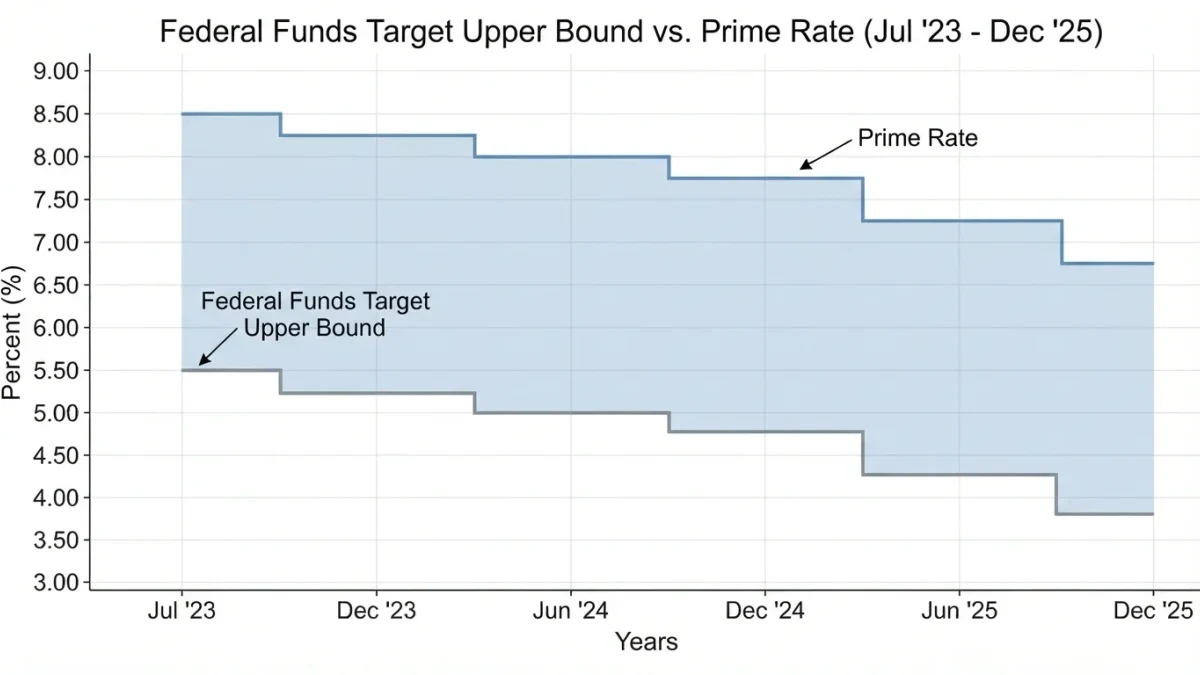
Lending spreads are priced in layers. A benchmark rate forms the base — the federal funds rate at the short end, or Treasury yields for longer loans. On top sits a credit spread that reflects the borrower's risk of default. On top of that sit the bank's operating costs and its profit target.
Risk grading does most of the work. A borrower with strong income and collateral gets a rate close to the base. A borrower with thin credit history pays several points more, because the bank expects a share of such loans to go bad. The portfolio is priced so that interest from the loans that perform covers the losses on the ones that do not.
That is also why credit card lending earns the widest spreads in consumer banking. Unsecured revolving debt has no collateral to seize, so expected losses are high and the rate must cover them. Our earlier look at Credit Card Charge-Offs: What Lender Data Showed in Q1 2026 shows what happens to those spreads when charge-off data deteriorates. Rate benchmarks themselves trace back to policy and auction markets, covered in Prime Rate vs. Fed Funds Rate: How They Differ and How Treasury Auctions Work and Set Yields.
Where do bank fees come from?
Fees are the second engine, and they are more visible than the margin. Account maintenance charges, overdraft penalties, wire transfer costs, ATM fees outside the network, and card interchange — the slice a merchant's bank pays to the card-issuing bank on every transaction — all fall in this bucket. For some institutions, fee income rivals lending income.
Fees also show up as inducements running in reverse. Banks pay bonuses to acquire deposits because deposits are cheap funding. TD Bank's own Beltsville branch page, for example, lists a $200 bonus for new TD Complete Checking customers with qualifying direct deposits, a $200 savings-account offer, and a small business checking promotion paying $500 cash back after 25 qualifying transactions and a $2,500 balance held for 90 days — conditions that keep the new funds in place. According to TD Bank's Beltsville location page, the same branch promotes a Double Up credit card earning 1% cash back on purchases plus another 1% when rewards are redeemed into an eligible TD deposit account — a structure designed to keep rewards money circulating inside the bank rather than leaving it.
Read a fee schedule the way an analyst reads a margin report. Every waived fee has a condition attached, and every bonus has a holding period. The offers are not generosity; they are customer-acquisition costs against future margin and fee income.
What does a branch actually do for the business?
Branches are the expensive retail layer of the model. They collect deposits in person, originate mortgages and small business loans, and sell services that digital channels handle poorly. The cost is real: leases, staff, security, and cash logistics all come out of the same margin that lending builds.
Branch density tracks where deposits are worth capturing. Bank branch locator data for a single Maryland suburb illustrates the point: a Beltsville, MD branch directory lists five branches of five different banks on one corridor — Bank of America, Capital One, PNC, TD Bank, and Sandy Spring Bank, each with one office. A competing directory, US Bank Locations, shows the wider picture around the same ZIP code, with hundreds of branches across nearby towns and full-service offices from Atlantic Union, Truist, and WesBanco within a few miles. Five banks competing for the same deposit base tells you how valuable local funding is.
Inside those branches, the sales mix leans toward products that deepen the relationship. Bank of America's Beltsville financial center page walks customers toward appointments covering everyday banking, home and auto loans, Merrill investing, and business services — each a hook for additional spread or fee income. The lobby is, in effect, an origination office wearing a retail storefront.
What breaks this model? Our analysis
Three things stress the model, and each has a mechanism rather than a mystery. First, rate shocks: if funding costs reprice faster than loan yields, the margin compresses until deposits and loans can be repositioned. Second, credit losses: a lending spread is only as wide as the losses it absorbs, which is why underwriting standards tighten visibly in downturns. Third, disintermediation: if customers move balances to higher-yielding alternatives, the cheap-funding advantage erodes and the bank must pay up or shrink.
What this means for a depositor is straightforward. The deposit rate you are offered is a funding cost to the bank, not a favor to you, and it resets on the bank's schedule, not yours. What this means for a borrower is the mirror image: your rate embeds your risk grade plus the bank's cost of funds, and it can change with the benchmark even if your own finances have not changed at all.
The honest limitation of this picture is that margins, fee mixes, and loss rates differ sharply between a community bank holding local mortgages and a money-center bank trading securities. The mechanism is the same; the weights are not. None of this is advice on where to keep your money — allocation depends on individual circumstances — but knowing which engine produces the profit makes every fee schedule and rate offer easier to read.
The takeaway on how banks make money
Banks earn from a spread they control by pricing risk, from fees attached to the accounts that fund them, and from services sold at the point of deposit. The branch on the corner is the visible tip of a funding machine. When you see a bonus offer, a promotional rate, or a cash-back card, you are watching the acquisition side of that machine at work — and the margin it is chasing is the answer to how banks actually make money.