
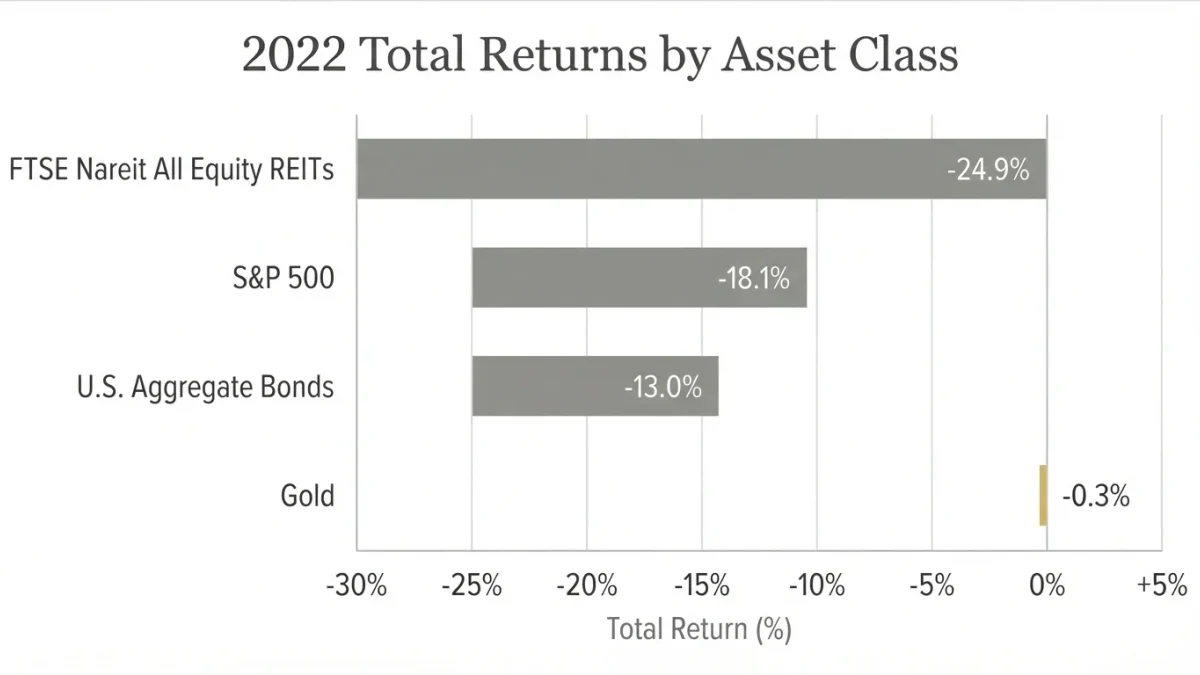
Gold and real estate investment trusts are the two real assets most cited in allocation: bullion, with no credit linkage or cash flow, and listed property companies required to distribute at least 90 percent of taxable income as dividends under U.S. tax rules. In 2022, REITs fell 24.9 percent, per Nareit, while gold was roughly flat.
This explainer documents the roles claimed for each asset, the recorded return and risk history, and the published criticisms.
What documented roles do gold and REITs claim?
Gold's claimed role is structural rather than contractual: it is no one's liability, pays no coupon, and its supply grows slowly regardless of demand. Frameworks that include it cite price behavior unlinked to credit cycles and a monetary history that predates every current currency — with the 2022 cross-asset drawdown as the recent supporting episode.
REITs claim a different role. A real estate investment trust is a listed company that owns income-producing property, and qualification under Internal Revenue Service rules requires distributing at least 90 percent of taxable income to shareholders annually. The result is a security whose documented function is converting rents into distributable income, with share prices that reprice property exposure daily.
Inflation linkage is claimed for both, through different mechanisms: rents and property values for REITs, and monetary substitution for gold. The claims are documented as claims — the record below shows when each held and when it did not.
What did the documented record show?
The REIT record is equity-like in both directions. The FTSE Nareit All Equity REITs index fell 24.9 percent in 2022 — more than the S&P 500's 18.1 percent decline that year — then returned 11.4 percent in 2023 as rates stabilized. Rate sensitivity, not property fundamentals alone, drove the swing in both documented directions.
Gold's record is episodic. It ended 2022 within a fraction of a percent of where it started while stocks and bonds fell together, rose roughly 27 percent in 2024 — its best year since 2010, per London Bullion Market Association pricing — and, in the same long record, spent more than two and a half decades below its January 1980 nominal peak before durably exceeding it in late 2007. The asset that held flat in 2022 also spent 1980 through 2007 going sideways in nominal terms.
Read together, the two records bracket the real-asset question: one asset with deep episodes of nothing and strong crisis-adjacent years, one asset with income documented every quarter and drawdowns deeper than the equity market's. Neither record projects forward, and neither role survives every regime.
How do they behave alongside stocks and bonds?
REITs are listed equities, and their co-movement reflects it. In 2022 they fell with — and beyond — the broad equity market as rising rates raised both discount rates and property financing costs; the diversification they add to a stock portfolio is documented as partial, not orthogonal.
Gold's co-movement is the weaker and the less stable of the two. Its flat 2022 against falling stocks and bonds is the episode frameworks cite; its long nominal sideways stretch from 1980 is the episode critics cite. Correlation estimates on gold swing widely across windows, which the diversification-measurement literature treats as the defining caution.
Both assets interact with the bond sleeve through rates. REIT balance sheets carry property debt whose cost resets with market yields, and gold — yielding nothing — competes with cash rates for the marginal allocator, which is one documented reason flat-to-falling real rates recur in explanations of its strong years.
What are the documented criticisms and defenses?
| Asset | Documented role | Documented criticism | Documented defense |
|---|---|---|---|
| Gold | No credit risk; 2022 flat performance during a stock-bond drawdown | No cash flow and no valuation anchor; nominal price below its 1980 peak until late 2007 | Monetary history; supply growth slow; crisis-adjacent episodes in the record |
| REITs | Income conversion; 90 percent distribution requirement; rent linkage | 2022 decline of 24.9 percent exceeded the equity market's; rate-sensitive leverage | Property income documented quarterly; 2023 rebound of 11.4 percent as rates stabilized |
The criticisms do not cancel the roles; they price them. A real-asset sleeve that adds episodes of offsetting behavior also adds episodes of deeper drawdown or longer stagnation than the portfolio it diversifies. Framework documents state the exchange explicitly rather than resolving it.
How do frameworks size real-asset sleeves?
Framework documents generally present real assets as satellite holdings around a stock-bond core, with ranges wide enough that the numbers signal philosophy more than precision. Index providers supply the building blocks — gold benchmarks and the Nareit-defined property universe — while the mixing weights are supplied by the framework, not the data.
An illustrative calculation shows why the ranges stay wide. Assume a 60/40 portfolio at 10 percent volatility and gold at 15 percent volatility with zero correlation to the mix; a 10 percent gold sleeve changes the portfolio's volatility only marginally under those stated assumptions, because the weight is small and the offset is imperfect. The same arithmetic that justifies the sleeve also caps what it can do — illustrative, not a forecast, and silent on returns by construction.
The documented caution follows from that asymmetry: a sleeve small enough to leave the portfolio's risk profile intact is also small enough to leave its return profile nearly unchanged in any given year. The 2022 episode — gold flat while everything else fell — was the exception the frameworks are built around, and the record marks it as an episode rather than a rule.
How are the two assets actually held?
Implementation is documented and narrow. Gold is held through bullion, exchange-traded products backed by allocated metal, and futures; each embeds different costs — custody and insurance for physical holdings, expense ratios for pooled vehicles, and financing terms for derivatives. REITs are held as listed shares or through pooled funds tracking the Nareit-defined universe, with the Securities and Exchange Commission registration and reporting requirements that attach to listed securities of this kind.
Two structural notes close the record. REITs' distribution requirement passes income out rather than retaining it for reinvestment, a property of the vehicle documented in the tax code itself. And pooled gold vehicles hold no rents, no leases, and no earnings calls — the documentation of their value is a price, an allocation list, and an audit.