
Age-based portfolio allocation is the practice of setting a portfolio's stock and bond weights using your age as the main input. The premise is that age may track two things that matter: how many years you have until you need the money, and how much time you have to recover from a downturn. But age is only one input, and treating any age-based formula as a personal recommendation is a mistake.
The honest answer to "what should my allocation be at my age?" is that it depends on individual circumstances no formula can see: your income stability, your debts, your goals, and how you actually react when markets fall. The rules of thumb in this guide are best used as sanity checks. If your current mix sits far from a rule-of-thumb split, that gap is worth understanding, not automatically closing.
Age itself is simple to define. As Merriam-Webster puts it, age is "the length of an existence extending from the beginning to any given time," and it is one of the stages of life at which particular capacities arise. In the most common Western counting system, age increases on a person's birthday, not continuously, as described by calculator.net and gigacalculator.com. That matters more than it sounds: an investor who is 39 years and 11 months old is still counted as 39, so any age-based split should be read as a band, not a precise setting.
What are the common age-based rules of thumb?
Two approaches are often described. One frequently repeated version of the older rule takes the form: your stock percentage equals some fixed number minus your age. The fixed number is not standardized; different tellings of the rule use different numbers, which is itself a reason to treat any single output as rough rather than precise. As pure arithmetic, a 30-year-old under a "100 minus age" version would hold 70 percent stocks; under a "120 minus age" version, 90 percent. The same investor, ten years later, would hold 60 or 80 percent respectively under those same versions.
The second approach is the target-date or glide-path fund, which is designed to hold a stock and bond mix that shifts automatically as a stated retirement year approaches. Funds of this type are built around a horizon date, so that picking the fund matching your horizon is meant to let the mix move without further decisions. The trade-offs of these funds, including how quickly they de-risk and what they hold, are covered in Glide Paths: Age-Based Allocation and the Debates.
Both approaches share an assumption: that the stock share should fall roughly in line with your remaining time horizon. That assumption is defensible. It is also the whole content of the rule. Everything else, how much to hold in cash, in which accounts, in which bond types, is left to the reader.
Why does age map to risk tolerance at all?
The mechanism is time, not the birthday itself. A long horizon gives a portfolio two abilities a short one lacks. First, it can wait out drawdowns: a deep bear market that lasts years is survivable if you do not need to sell during it. Second, it allows ongoing contributions to buy through the trough, which matters more for young savers than any single year's return.
As the horizon shortens, those abilities fade. Someone retiring in two years cannot wait out a multi-year recovery, because selling into a drawdown locks in losses. This is the real argument behind age-based allocation, and it is a good one.
But note what the argument actually supports: allocation should follow time horizon, not age. A 45-year-old planning to retire at 50 and a 45-year-old planning to retire at 70 have the same age and very different appropriate mixes. Horizon is the causal variable. Age is a rough proxy for it, and the proxy fails whenever goals, health, or plans deviate from the typical path.
Where do the formulas break down?
Three failures recur.
- Human capital. Your future earnings are part of your real financial position. A tenured civil servant with a stable pension and a freelance worker with lumpy income may be the same age, but the civil servant can safely hold more volatile assets, because the stable paycheck functions like a bond. Age-based formulas cannot see this.
- Fixed liabilities. A mortgage, dependents, or an expected family obligation change how much of a portfolio can bear risk. An investor with a large emergency reserve, the buffer described in Emergency Funds and Their Place in Allocation, can tolerate more drawdown than an otherwise identical investor without one.
- Behavioral risk tolerance. The formula assumes you will hold the mix through a crash. Many investors do not. A mix you abandon in a panic performs worse than a more conservative mix you actually keep. The distinction between tolerance (how much risk you can bear) and capacity (how much you can bear given your situation) is developed in Strategic vs. Tactical Asset Allocation: How They Differ.
There is also a criticism sometimes raised from the other direction: mechanical de-risking may be too crude, because it can ignore valuation levels and the actual shape of an investor's spending needs. Both sides of that debate are laid out in the glide-path piece above; the formulas are not adjudicated here because the evidence does not settle them.
How should the rules be used as a sanity check?
Practical steps, in order:
- Compute your current split. Add up stock and bond holdings across all accounts. Include retirement accounts; the location of assets across accounts is a separate question, covered in Asset Location: Which Assets Go in Which Accounts.
- Compute the rule-of-thumb range. Run two or three versions of the fixed-number-minus-age formula. Treat the spread between them as the honest uncertainty in the rule, not a precision problem to solve.
- Compare, then explain the gap. If you hold far more stocks than any version suggests, ask why: a longer horizon, a stable income, or simply risk you have not felt yet. If you hold far fewer, ask whether that reflects genuine capacity limits or loss aversion.
- Stress-test the behavioral side. Review how you responded to past drawdowns, if you have lived through any. A mix that was abandoned at the bottom was the wrong mix, whatever the formula said.
What this means: the gap between your actual mix and a rule-of-thumb split is information. It is a prompt to articulate your horizon, your liabilities, and your temperament. Closing the gap mechanically, without that reasoning, is not the point of the exercise.
What role do cash and other assets play?
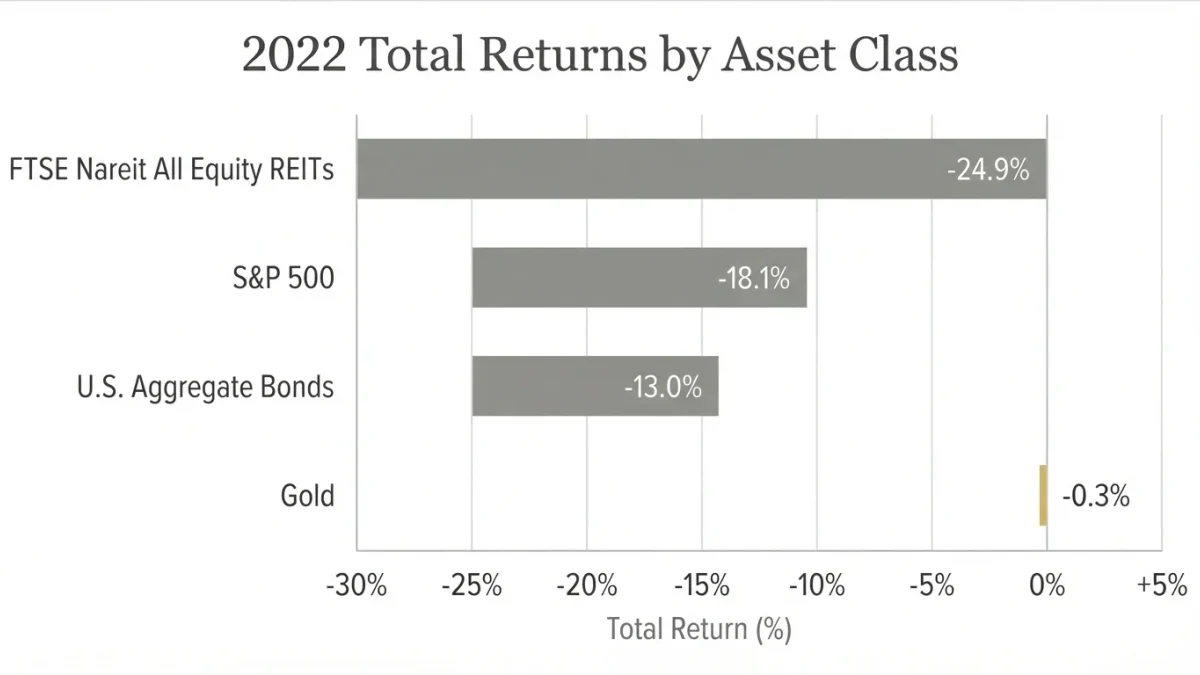
Stock and bond splits are the headline, but they are not the whole allocation. Cash serves a distinct function, liquidity and stability, that neither stocks nor bonds fully replace; its actual mechanics are covered in Cash as an Asset Class: What It Actually Does. Real assets such as gold and real estate investment trusts are sometimes added for diversification; whether they help in any particular case is not evaluated here, and the considerations are laid out in Gold and REITs: Real Assets in a Portfolio. Crypto assets, where held, sit inside the same discipline as everything else: they can lose most or all of their value quickly, and no age-based formula accounts for them. Their portfolio context is covered in the site's crypto section.
Bond structure matters too. Whether bonds are held as individual ladders or as funds changes interest-rate and reinvestment behavior without changing the headline percentage; the comparison is in Bond Ladders vs. Bond Funds: How They Compare.
What the evidence supports, and what it does not
What is well established: allocation should shift with time horizon, and age is a serviceable proxy for horizon in the typical case. What the rules of thumb cannot establish: the right split for any particular person, because they exclude income stability, liabilities, account types, and behavior. No historical return figure is projected forward here, because past data does not determine future outcomes.
This article is information and education, not investment advice. Any allocation decision depends on individual circumstances, and readers weighing a change to their mix may want input from a qualified adviser who can see those circumstances. The formulas are worth knowing. They are worth knowing as questions to ask, not answers to copy.