Asset location is the placement of holdings across taxable, tax-deferred, and tax-exempt accounts so that each asset sits where its tax treatment does the least documented damage. Dammon, Spatt, and Zhang's 2004 Journal of Finance analysis found after-tax wealth increases when taxable bonds occupy tax-deferred accounts and equities occupy taxable ones.
This explainer documents the framework's rules, its placements, and the criticisms recorded in the research.
What are the three account types and their tax rules?
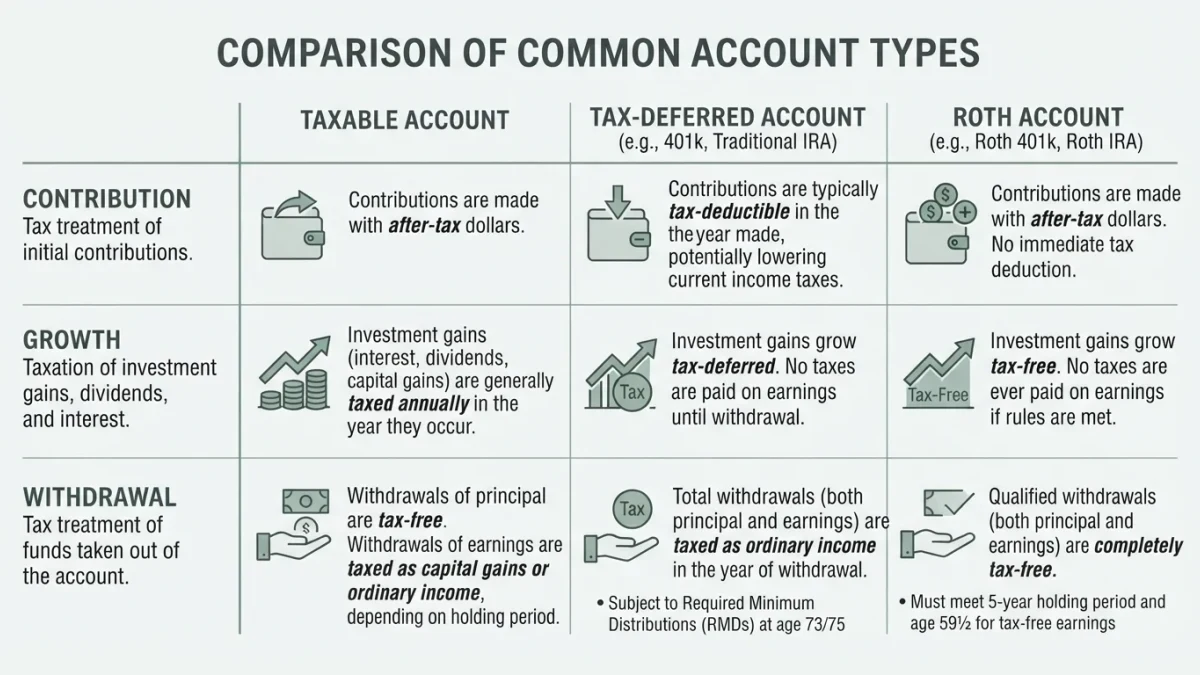
Taxable accounts are funded with after-tax money and taxed as they go. Interest and non-qualified dividends are taxed at ordinary income rates, while qualified dividends and long-term capital gains follow the 0, 15, and 20 percent schedules plus the 3.8 percent net investment income tax above thresholds, per Internal Revenue Service rules. Realized losses can offset realized gains, a property no tax-advantaged wrapper shares.
Tax-deferred accounts — the traditional 401(k) and the traditional individual retirement account — deduct contributions in the contribution year and tax withdrawals as ordinary income. The employee deferral limit for 401(k) plans was 23,500 dollars in 2025 per IRS Notice 2024-80, and required minimum distributions generally begin at age 73 under the SECURE 2.0 Act of 2022.
Roth accounts take after-tax contributions and pay no tax on qualified distributions. The IRA contribution limit was 7,000 dollars for 2025. Inside both wrappers, the tax code is blind to which asset sits where until money crosses the boundary — the property the entire location framework exploits.
The framework also assumes a household view rather than an account view. Holdings are ranked across every account at once, so an individual account can look unlike the target allocation while the household total matches it. Practitioner documents describe this as the hardest step to maintain, because statements report account by account and the intended picture exists only in aggregate.
How does the standard framework assign assets?
The framework ranks assets by tax friction. Income taxed at the highest ordinary rates goes where ordinary taxation is deferred or absent; returns that are already deferral-friendly stay where their favorable treatment is usable. The placements below are the documented framework, not a recommendation for any reader's accounts.
| Asset type | Framework placement | Documented rationale |
|---|---|---|
| Taxable bonds | Tax-deferred first | Coupon interest is ordinary income; deferral shields the highest-friction stream |
| Real estate investment trusts | Tax-deferred | Distributions are largely non-qualified dividends taxed at ordinary rates |
| Broad equity index funds | Taxable | Low turnover defers capital gains and converts income to qualified dividends |
| Municipal bonds | Taxable only | Interest is already federally exempt; sheltering it in a wrapper wastes the wrapper |
| Highest expected-growth assets | Roth, per the framework | Tax-free withdrawal captures compounding — on the assumption that growth ordering is knowable, itself criticized |
Two placements attract most of the debate. The Roth row assumes an investor can rank growth in advance, which the record does not support reliably; and the taxable-equity row depends on low portfolio turnover, a property of the vehicle rather than of equities themselves.
What is the documented benefit worth?
The research frames the gain as modest but real. Shoven and Sialm's 2000 NBER analysis estimated that optimal location adds the equivalent of a small constant to annual after-tax return, with the advantage largest when taxable and tax-advantaged balances are similar in size. Dammon, Spatt, and Zhang's 2004 optimization found the bond-deferred, equity-taxable arrangement raises after-tax wealth and that the advantage widens as the bond-equity return gap widens.
The estimates carry stated assumptions: static tax law, fixed return gaps, and long holding periods. Bracket changes over a career can reverse the traditional-versus-Roth calculus that sits beneath every placement, which is why the papers present location as an optimization conditional on assumptions rather than a universal ranking.
An illustrative calculation shows the scale. Assume 100,000 dollars of taxable bonds yielding 4.5 percent in a taxable account at a 24 percent federal bracket: the 4,500 dollars of annual interest draws 1,080 dollars of tax each year, which no longer compounds for the holder. The same bonds in a tax-deferred account defer that amount until withdrawal — illustrative arithmetic under stated assumptions, before any state tax, and not a projection of any investor's outcome.
How does location interact with rebalancing and complexity?
Rebalancing cuts across placements. Corrective trades inside a taxable account realize gains that wrappers would defer, so practitioner documents describe using tax-advantaged accounts as the rebalancing room whenever the drift appears there. A location plan therefore changes where the rebalancing naturally happens, not whether it is needed.
The standing criticism of the entire framework is complexity cost. Maintaining placements across several accounts, each with different custodians and contribution calendars, has a documented failure mode: households that abandon the scheme partway and end up with neither the simplicity of identical accounts nor the placement the framework intended. The simpler alternative documented in the literature — holding the same allocation everywhere — sacrifices the estimated gain but survives neglect.
Where does the framework break down?
Space is the first constraint. When a bond allocation exceeds the available tax-deferred room — common for savers whose 401(k) balances are small relative to taxable holdings — the documented optimum bends, and some ordinary-income assets sit in taxable accounts regardless. The framework acknowledges the constraint rather than dissolving it.
Sequencing is the second. Required minimum distributions from tax-deferred accounts create forced income in retirement that can raise the tax rate on later withdrawals, a documented interaction between location and withdrawal order. Location set in accumulation can therefore be revisited — or regretted — in decumulation.
Priority is the third. The framework documents themselves rank total allocation and costs above location in determining after-tax outcomes: what is owned and what it costs matter more than where it is shelved. Location refines a plan; it does not substitute for one.
The order of operations documented across the framework papers is consistent on that point: decide the allocation, control the costs, then optimize the shelf. Reversing the order spends effort where the literature finds the smallest after-tax lever of the three.