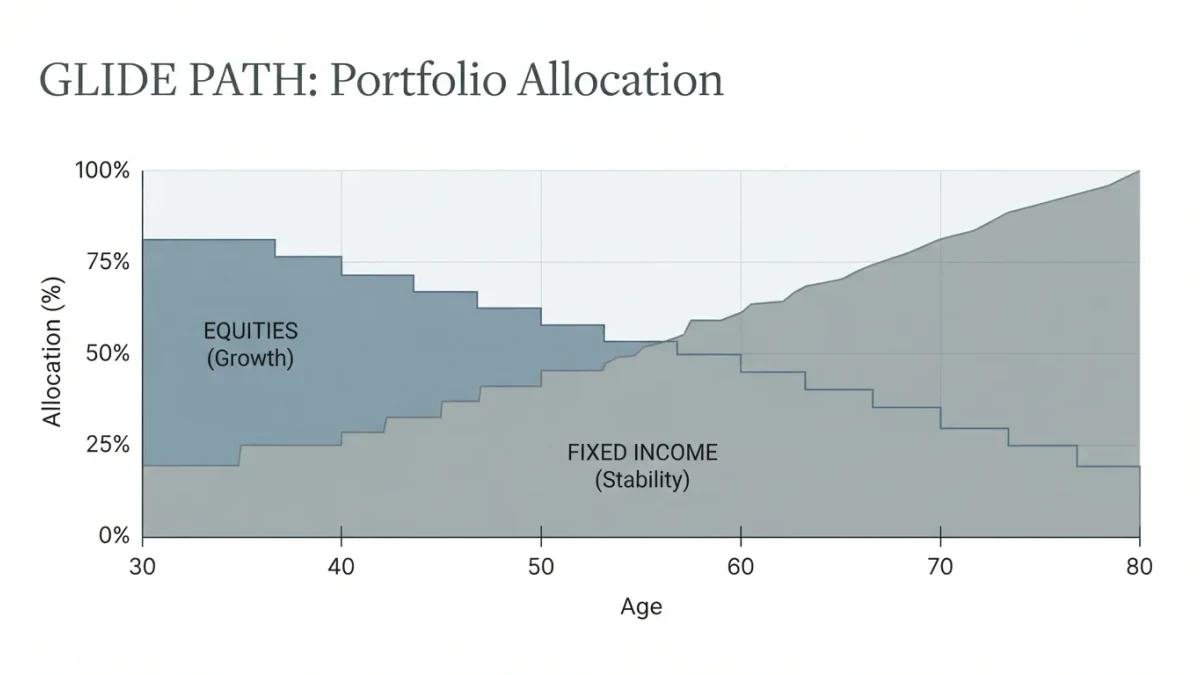

A glide path is the scheduled change in a portfolio's asset mix over time, most visibly inside target-date funds, where equity weight typically declines as the fund's named retirement year approaches. U.S. target-date strategies held more than 3 trillion dollars by 2024, per Morningstar, after 2006 legislation made them a standard plan default.
This explainer documents how glide paths work, where their age-based rules come from, and the published debates over their design.
What is a glide path, exactly?
A glide path is a schedule, not a strategy: it fixes the equity weight for each year between enrollment and the target date, so the portfolio de-risks on a calendar regardless of market conditions. The endpoint — the landing point — is the equity weight the schedule reaches at or after the target year, and it varies materially between designers.
Design vocabulary distinguishes 'to' from 'through.' A glide path that is 'to' the target date stops changing once the year arrives, holding its landing point from then on. A 'through' path keeps declining for twenty or thirty years after the target date, on the reasoning that retirement is the start of a multi-decade holding period rather than a liquidation date.
The distinction is documented, material, and often invisible on a fund's marketing page. Two funds carrying the same vintage year can differ by tens of percentage points of equity at the target date purely because one designer stops where the other keeps going — the dispersion documented below made that difference famous.
Where do age-based allocation rules come from?
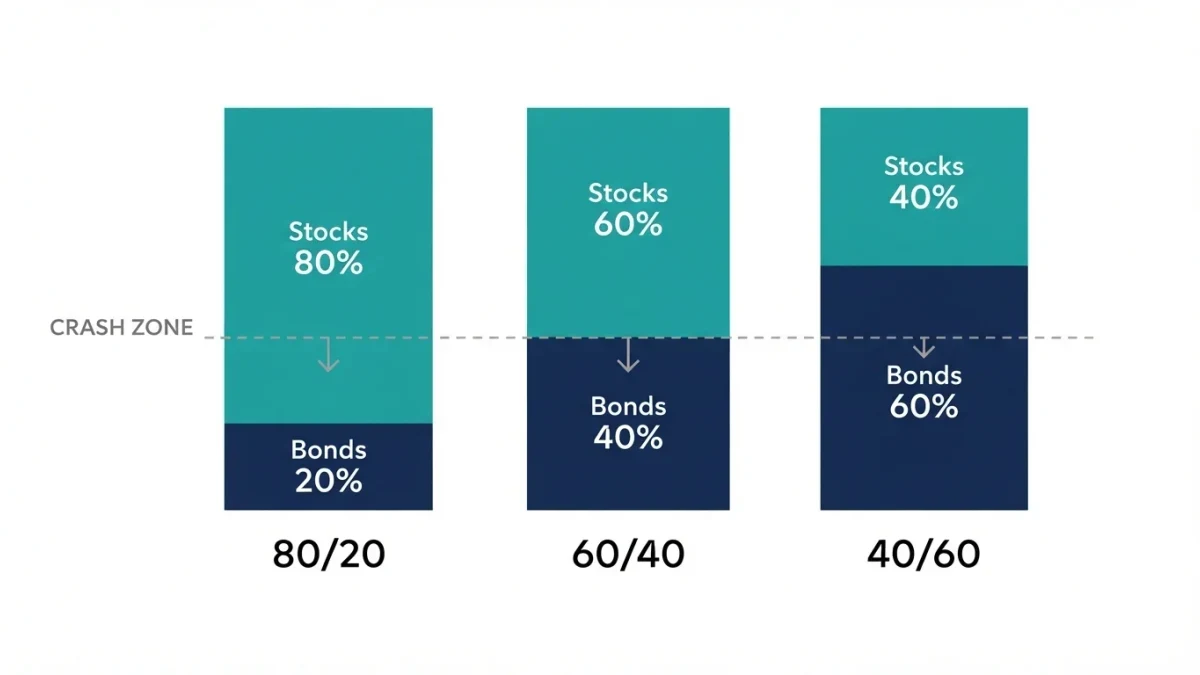
The oldest widely quoted rule is arithmetic: hold the figure produced by 100 minus one's age in stocks, the rest in bonds. Its origin is not documented to a single author, which the honest treatments state plainly; it circulated as practitioner guidance through the second half of the twentieth century, an era of shorter retirements and higher typical bond yields.
The rule's documented weaknesses follow from its inputs. It knows only age — not interest rates, longevity, spending needs, or other assets — and it therefore produces the same answer in a 2-percent-yield world and an 8-percent one. Allocation research treats it as a mnemonic of an older demographic era rather than a framework with stated assumptions.
The research-grade descendant is withdrawal-rate analysis. William Bengen's 1994 Journal of Financial Planning study, which introduced the 4-percent initial withdrawal benchmark from historical sequences, also found that equity allocations between roughly 50 and 75 percent sustained withdrawals across the retirement periods he studied — a range, not a point, and one that already contradicted a fixed rule keyed to age.
How do target-date funds implement glide paths?
A target-date fund industrializes the schedule. Each vintage year gets one fund holding every participant of that age, and the manager executes the glide path inside it, trading so the participant does not. The U.S. Department of Labor designated such funds as qualified default investments after the Pension Protection Act of 2006, which is how they became the automatic landing spot for unassigned plan contributions.
The default status drove documented adoption. Plan-level series such as Vanguard's How America Saves record nearly all large plans offering a target-date series and a majority of participants holding one, with much of that holding acquired by default rather than selection. Scale followed: Morningstar's tally put U.S. target-date strategies above 3 trillion dollars by 2024.
Implementation embeds choices beyond the slope. Designers pick the asset menu (domestic equity, global bonds, inflation-linked securities, real assets), the rebalancing frequency, and the landing point — and each choice is documented to vary across families, which is why two same-vintage funds are different products.
What are the documented debates and criticisms?
The 2008 episode set the terms. Funds sharing the 2010 target date — three years from retirement on paper — carried equity allocations at the target that ranged from roughly one-quarter to more than two-thirds across families, and their 2008 losses differed accordingly, by tens of percentage points between products with the same label. Government Accountability Office review in 2011 documented the dispersion and the disclosure gaps behind it.
| Rule or design | Documented assumption | Documented criticism |
|---|---|---|
| 100 minus age in stocks | Age alone summarizes risk capacity | Origin undocumented; ignores rates, longevity, and other assets |
| Declining glide path to the target date | Retirement dates mark a risk cliff | 2008 dispersion among same-vintage funds; landing points vary widely |
| Through design, declining past the target | Retirement is a multi-decade holding period | Higher equity at retirement deepens early-sequence drawdowns |
| Rising equity glide path in retirement | Kitces and Pfau's 2014 simulations found lower failure risk when equity weight rises after retirement | Contradicts the age rule's direction; depends on historical sequences studied |
The rising-glide-path result deserves its row. Michael Kitces and Wade Pfau's 2014 Journal of Financial Planning analysis found that, across historical sequences, allocations that started conservative and grew more equity-heavy through retirement reduced failure risk for many withdrawal rates — the opposite slope from every age rule then in print. The finding is documented, contested in its assumptions, and cited on both sides of the design debate.
The one-size criticism stands above all of them. A single schedule keyed to birth year cannot distinguish a renter from a homeowner, a pensioner from a saver, or a 62-year-old retiree from a 62-year-old plan participant; the design answers none of those questions, and the record shows it was never asked to. The documented defense is equally plain: as a default for households that would otherwise hold cash, the funds raised diversification measurably in plan data.
The debates therefore do not concern whether a schedule should exist — inertia documented in plan data settled that question years ago — but what the schedule should assume about the decades it spans. Slope, landing point, and the treatment of the years after the target date remain designer choices, published fund by fund, and readable in each fund's most important disclosure: its stated glide path.