Self-custody is the practice of holding crypto assets under one's own private keys, with no exchange or custodian between owner and ledger. Recovery rests on a 12- or 24-word seed phrase, standardized in 2013-2014: one holder documented in a 2021 New York Times report was locked out of 7,002 bitcoin after losing his keys.
Self-custody addresses key risk only. Crypto assets can lose most or all of their value quickly, and keys held perfectly do not change that.
What Are Public and Private Keys?
Every crypto balance is controlled by a key pair. The private key is a large random number used to sign transactions; the public key, derived from it, can be shared openly and used to verify signatures without revealing the signer. Bitcoin and Ethereum use elliptic-curve cryptography for this derivation, and addresses are further-derived shorthand for the public side. The mathematics runs one way: deriving a public key from a private key is instant, and no known method reverses it.
Control, therefore, is the ability to sign. Whoever holds the private key can move the coins from anywhere, on any compatible software, without permission, identity checks, or delay. Whoever loses the key holds nothing recoverable, because there is no account, no password reset, and no customer service attached to the blockchain itself. That asymmetry is the entire design: the system replaces institutions with mathematics, and it replaces institutional recovery with personal responsibility.
What Is a Seed Phrase and Why Does One Phrase Control Everything?
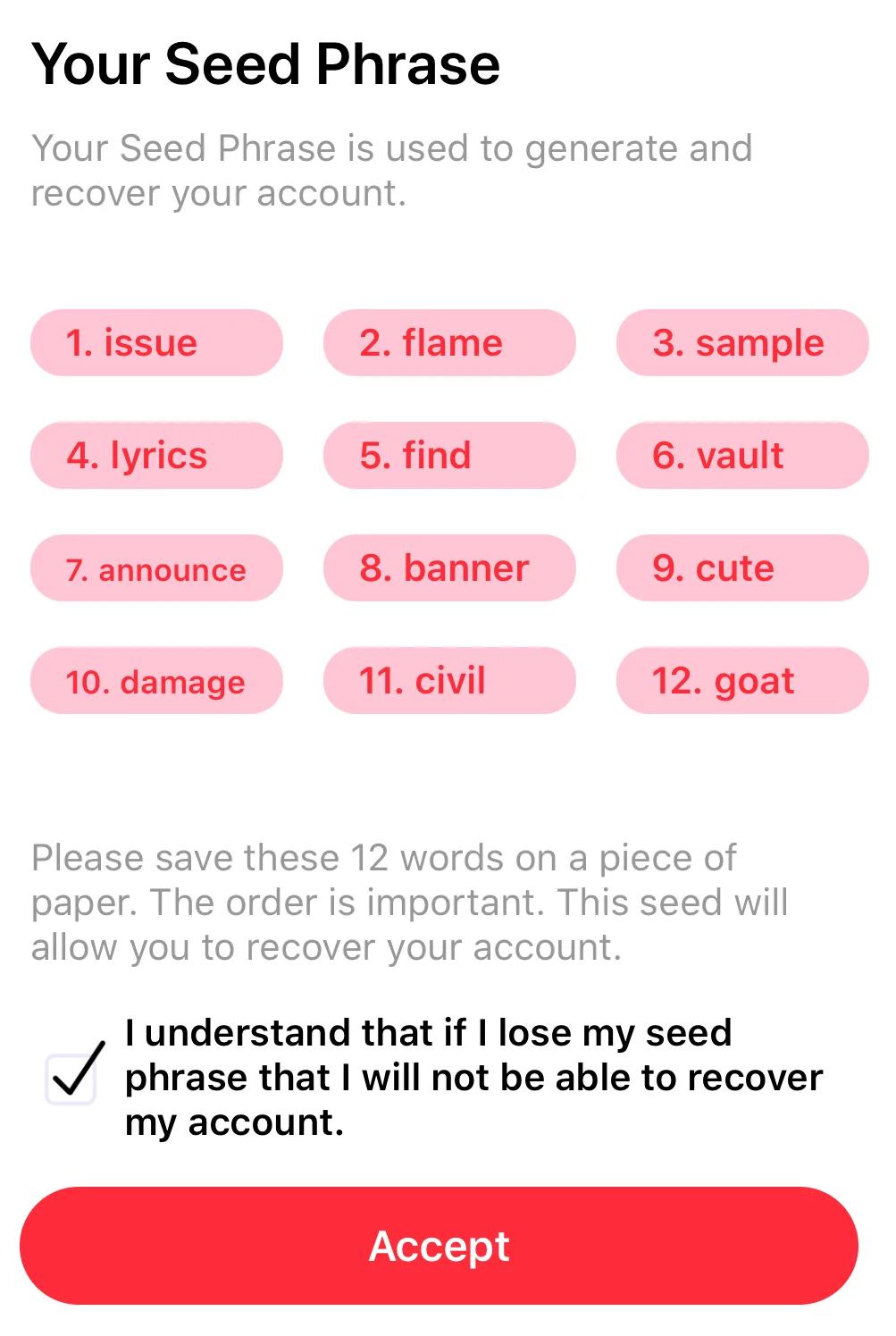
A seed phrase is a human-readable encoding of the random starting point from which a wallet derives every private key it will ever use. The format, standardized in Bitcoin Improvement Proposal 39 in 2013, draws words from a fixed list of 2048, so a 12-word phrase encodes 128 bits of entropy and a 24-word phrase encodes 256. The earlier BIP-32 standard from 2012 defined how one seed deterministically generates a tree of key pairs, which is why one phrase backs up an entire wallet, including future addresses generated years later.
The convenience is also the concentration of risk. A seed phrase restores every derived key, so a single leaked phrase empties every account it governs, and a single destroyed phrase strands every one of them. Twelve words carry enough entropy that guessing is infeasible, but humans defeat that margin through storage mistakes, photographs, cloud notes, and phishing, which is where documented losses actually occur. The engineering is strong; the operational layer around it is where self-custody fails in practice.
How Do Holders Back Up and Protect Keys?
Documented practice treats the seed as an irreplaceable document, closer to a bearer bond than a password. The usual sequence, described across wallet vendors' security guides, looks like this:
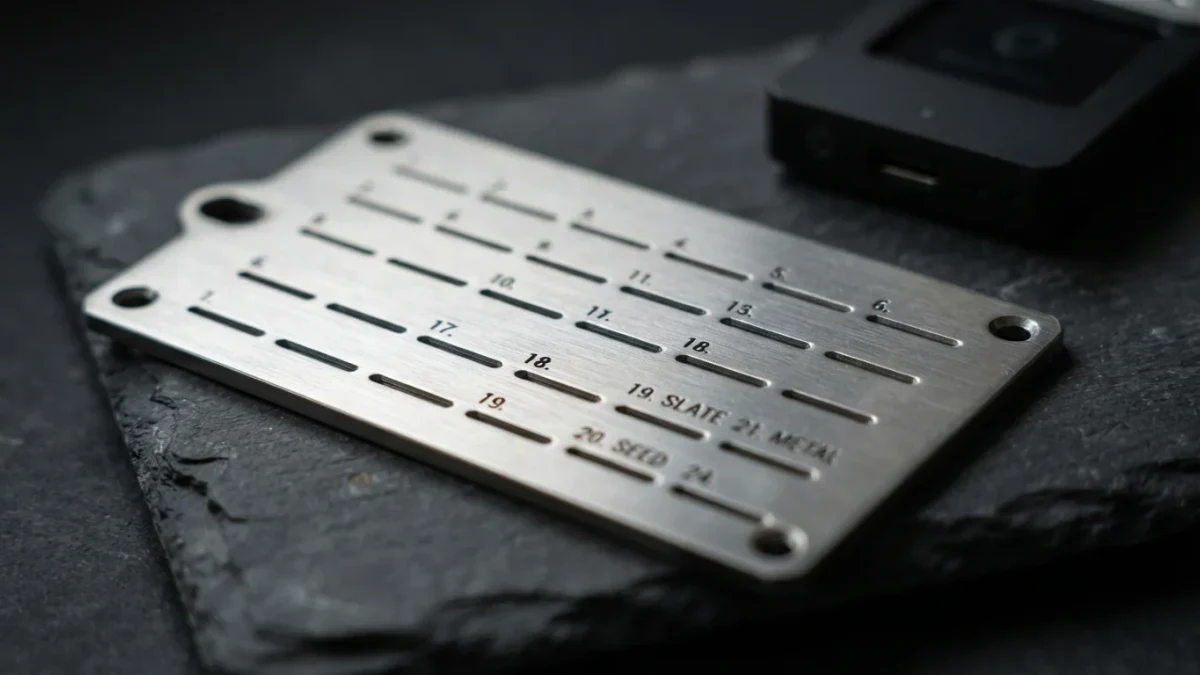
- Record. Write the words by hand on durable material, in order, exactly as displayed; metal plates stamped with the words survive fire and flood that destroy paper.
- Verify. Test the backup by restoring the wallet on a separate device before funding it meaningfully.
- Redundancy. Keep copies in separate physical locations, so a single disaster cannot eliminate all of them.
- Optional passphrase. A so-called 25th word adds a secret only the holder knows, at the cost of being unrecoverable if forgotten.
- Access controls. Never type the phrase into a website, phone camera, keyboard app, or cloud document; legitimate services never request it.
Attack patterns documented by regulators concentrate on exactly these steps. Phishing pages imitating wallet interfaces, clipboard malware that swaps destination addresses, and fake support staff asking for recovery phrases recur in the CFTC's investor-education materials on digital-asset fraud. The common thread is that the attacker needs the holder's cooperation for a moment, once.
What Are Multisignature and MPC Arrangements?
Single-key self-custody concentrates everything in one secret, so stronger setups split control. Multisignature wallets require several independent keys, with a quorum, such as two of three, needed to spend; keys can be distributed across locations or people, so one theft or one loss does not strand the funds. Multi-party computation wallets split one key into shares held by separate devices or parties, with signing done collaboratively and the full key never assembled anywhere. Both patterns appear in individual, family, and institutional setups.
The tradeoff runs toward availability risk. A quorum that is hard for an attacker to assemble is also hard for an owner to assemble under stress, and lost shares or forgotten procedures strand funds as effectively as a lost seed. Complexity itself is a documented failure mode: improvised schemes that their designers cannot reliably re-execute years later defeat the purpose. The choice among single-key, multisignature, and MPC setups is a bet on which failure the holder can best avoid, and it depends on circumstances that vary person to person.
What Does the Documented Loss Record Show?
Loss estimates are large enough to be a defining feature of the asset class. Chainalysis estimated in 2020 that about a fifth of all bitcoin then in existence, roughly 3.7 million coins, sat in wallets whose keys were lost or stranded. Individual cases anchor the statistic: the 2021 New York Times profile described a programmer with 7,002 bitcoin on an encrypted drive with two password attempts remaining, and the British engineer who discarded a drive holding 8,000 bitcoin spent years seeking permission to excavate a landfill before a London court dismissed his claim in January 2025.
The record on the theft side is equally documented, and it does not spare self-custody. Beyond exchange breaches, individuals lose keys to phishing, fake applications, physical theft, and coercion, and estate proceedings routinely reveal backups no heir can find or interpret. None of these cases involve broken cryptography. They involve the human perimeter around the keys, which is the perimeter self-custody makes decisive.
What Responsibility Tradeoffs Come With Self-Custody?
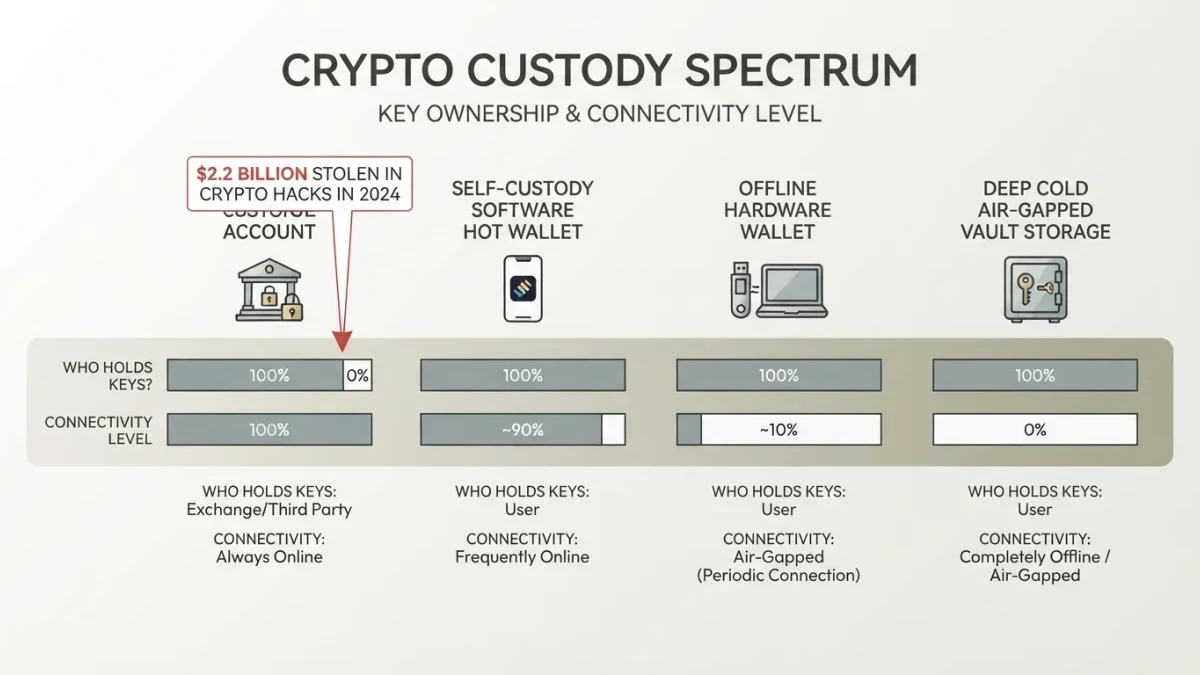
Self-custody is a transfer of operational risk from institutions to the holder, and the documented tradeoffs run in both directions. The table compares the arrangement on the dimensions the loss record shows matter most.
| Dimension | Self-custody | Custodial holding |
|---|---|---|
| Counterparty risk | None; no platform to fail | Exchange hack, freeze, or insolvency |
| Recovery path | Seed phrase only; no reset | Identity verification, support channels |
| Transaction friction | Full control, full responsibility | Platform approval, limits, hours |
| Inheritance | Requires explicit planning | Follows account-claim procedures |
| Learning burden | Substantial and ongoing | Minimal |
Neither column is superior in the abstract; each is a bundle of risks suited to different circumstances, capabilities, and contingencies. What the documented record argues is that the choice deserves the same deliberate planning as the assets themselves, because the failure modes are permanent. And regardless of custody choice, the market risk is unchanged: crypto assets can lose most or all of their value quickly, held in a wallet or on a platform alike.