Crypto custody is the set of arrangements under which the private keys controlling a crypto asset are stored and protected. The distinction between hot wallets, which stay connected to the internet, and cold storage, which stays offline, is a risk-management choice: in February 2025, hackers stole about $1.5 billion from the exchange Bybit, the largest documented crypto theft.
Crypto custody decisions address key risk, not market risk. Crypto assets can lose most or all of their value quickly, and no storage arrangement changes that exposure.
What Is the Difference Between a Hot Wallet and Cold Storage?
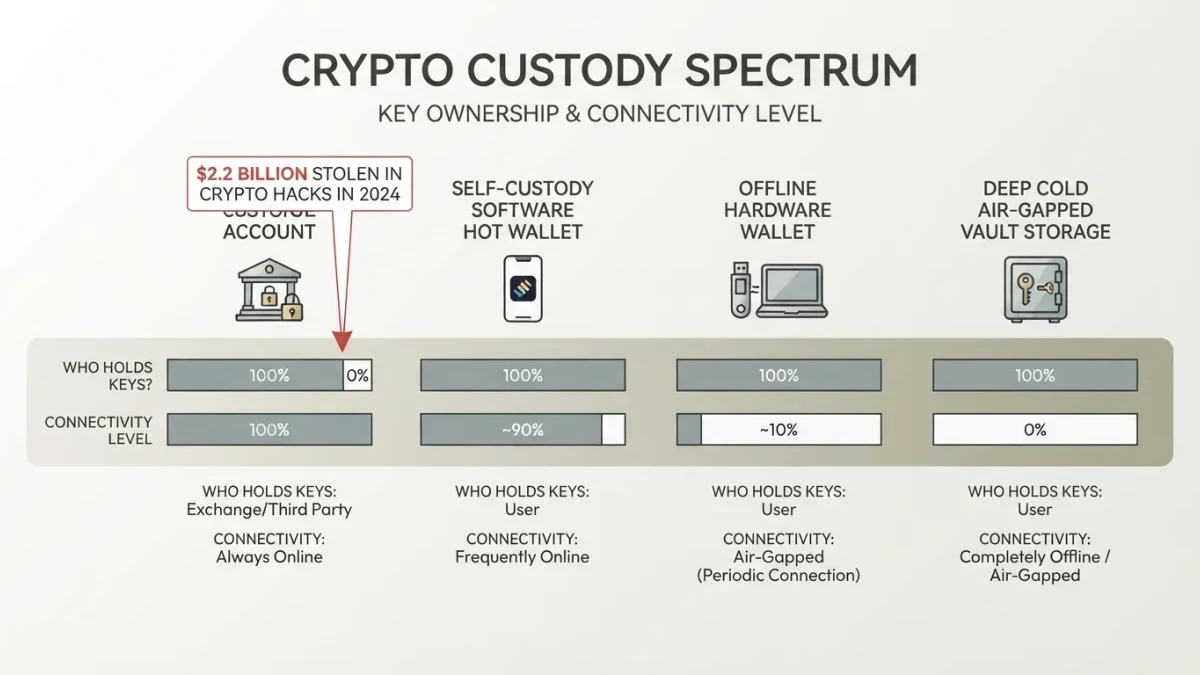
A hot wallet is any key arrangement connected to the internet while in use, such as an exchange account, a browser extension, or a phone application, while cold storage keeps keys on devices or media that never touch a live network. The difference is exposure, not the asset itself: the same bitcoin exists either way, and the placement determines which failure modes apply. Hot custody optimizes for availability; cold custody optimizes for resistance to remote attack. Most documented frameworks treat custody as a spectrum rather than two boxes.
Concrete examples place themselves along that spectrum. An exchange account is custodial hot storage: the platform holds the keys and approves withdrawals. A mobile software wallet is self-custodial hot storage: the holder's phone holds the keys, which an online attacker can reach. A hardware wallet is cold storage: transactions are prepared on a connected device, signed inside the hardware in isolation, then broadcast, so keys never appear on the internet-facing machine. At the far end, deep cold arrangements use air-gapped computers or engraved metal backups stored in safes or vaults.
Why Does Key Control Define Crypto Custody?
Control of a crypto balance is control of the private key able to authorize a spend, which makes key possession the practical definition of custody. In custodial arrangements the platform holds that key; in self-custody the holder does, typically through a seed phrase that regenerates the keys. There is no separate registry of account title the way securities and bank records have, so whoever can sign can move the asset. The educator's phrase "not your keys, not your coins," popularized in community writing during the 2010s, compresses exactly this point.
The legal backdrop differs from banking and brokerage. U.S. bank deposits are backed by federal deposit insurance and brokerage customers by statutory protection schemes, but neither scheme extends to crypto balances. The FDIC repeatedly warned between 2023 and 2025 that crypto assets are not insured deposits and that some marketing implying otherwise was misleading. A balance held at a platform is a claim against that platform, and the platform's custody choices become the customer's exposure.
What Are the Documented Risks on Each Side?
Hot custody's documented failure mode is remote attack, and the record is long. Mt. Gox lost roughly 850,000 BTC in the collapse it disclosed in February 2014. Japan's Coincheck reported about $530 million stolen in January 2018. In February 2025, the BBC reported that $1.5 billion had been taken from Bybit, about 401,000 ETH, in what the exchange called the largest theft in the industry's history. Chainalysis counted about $2.2 billion stolen across crypto hacks in all of 2024.
Custodial risk extends beyond hacking. FTX, which filed for Chapter 11 protection in November 2022, did not lose keys to thieves; a U.S. court later heard that customer assets had been misdirected to an affiliated trading firm, leaving customers as creditors in a bankruptcy process. That distinction matters for custody analysis: key theft and counterparty misuse are separate failure modes, and hot custodial arrangements carry both.
Cold storage trades remote attack risk for human risk. Keys and seed phrases can be lost, destroyed, or forgotten, with no password-reset path, and documented cases include holders permanently locked out of large balances and heirs unable to locate backups. Physical theft, coercion, fire, and flood replace phishing and exchange breaches as primary scenarios. Attack research against hardware wallet firmware has also been published, which is why vendors ship firmware updates and why deep cold setups minimize the number of people and devices that ever touch the keys.
How Does the Custody Spectrum Work in Practice?
In practice, custody is arranged in layers, with keys split between convenience float and offline reserves. The table summarizes the common arrangements and their primary failure modes, as documented in institutional custody literature and the loss record above.
| Arrangement | Keys held by | Connectivity | Typical use | Primary failure mode |
|---|---|---|---|---|
| Custodial exchange account | Platform | Always online | Trading, frequent transfers | Hack or platform insolvency |
| Software wallet (self-custody) | Holder's device | Online in use | Small balances, payments | Malware, phishing, device loss |
| Hardware wallet | Holder's device, offline signing | Offline except broadcasts | Personal long-term holding | Seed loss or physical theft |
| Multisignature vault | Several keys, quorum required | Mixed | Businesses, shared treasury | Quorum unavailable, procedure error |
| Deep cold storage | Air-gapped media, geographic spread | Never online | Large reserves, estates | Loss, disaster, inheritance gaps |
How Do Institutions Handle Crypto Custody?
Institutions operate inside a regulatory perimeter that individual holders can study as a reference model. The SEC amended its Customer Protection Rule in 2023 to tighten how broker-dealers safeguard digital asset securities, and the OCC granted Anchorage Digital a national trust charter in 2021, the first federally chartered digital asset custodian. New York has licensed and supervised custodians under its banking rules since 2015. The spot bitcoin exchange-traded products approved in January 2024 each named an independent third-party custodian in their filings, which is the standard structure for pooled vehicles.
Institutional custody is not risk elimination. The Bybit theft reportedly reached a wallet designated as cold through a compromised signing interface, per BBC reporting on the exchange's February 2025 disclosure, which made operational hygiene rather than the label decisive. Institutional designs therefore emphasize segregated cold reserves, multisignature controls, insurance coverage for theft, and independent audits. These controls reduce specific documented risks; they do not remove the market risk of the assets themselves.
What Should Readers Weigh Before Choosing a Custody Arrangement?
The documented decision factors are practical rather than technical, and they interact with individual circumstances: transaction frequency, size of balances, counterparties involved, backup and recovery procedures, inheritance planning, and the operational discipline the holder can sustain. Each factor favors a different point on the spectrum. What the record argues against is the assumption that any single arrangement removes risk; it relocates risk between remote attackers, platform counterparties, and the holder's own procedures.
- Frequency: moving balances for trading or payments argues for some hot capacity; long periods of inactivity argue for offline storage.
- Counterparty: custodial arrangements convert key risk into platform risk, which the FTX and Bybit episodes illustrate from different directions.
- Recovery: cold arrangements are only as strong as backups and inheritance documentation, a documented weak point in estate proceedings.
Two risk axes stay separate throughout: key risk, which custody addresses, and market risk, which it does not. Crypto assets can lose most or all of their value quickly regardless of where the keys are stored. Any custody choice sits on top of that volatility, not beneath it, and the two questions deserve separate analysis.