
Alternative asset allocation is the practice of placing a defined portion of a portfolio in assets outside the standard stock-and-bond split, such as gold, real estate investment trusts (REITs), and commodity futures. The purpose is not higher return. The purpose is exposure whose behavior differs from stocks and bonds, so the whole portfolio is less dependent on how those two asset classes perform together.
The honest starting point is that the word "alternative" simply means something chosen instead of the conventional option. As The Free Dictionary defines it, an alternative is "one of a number of possible choices or courses of action" — and in portfolio terms, the choice is between the standard mix and a mix that adds sleeves built from other things. Which sleeves deserve room is a question about mechanism: what each asset actually does, who bears the risk, and what breaks when the assumption behind it fails.
What problem is an alternative sleeve supposed to solve?
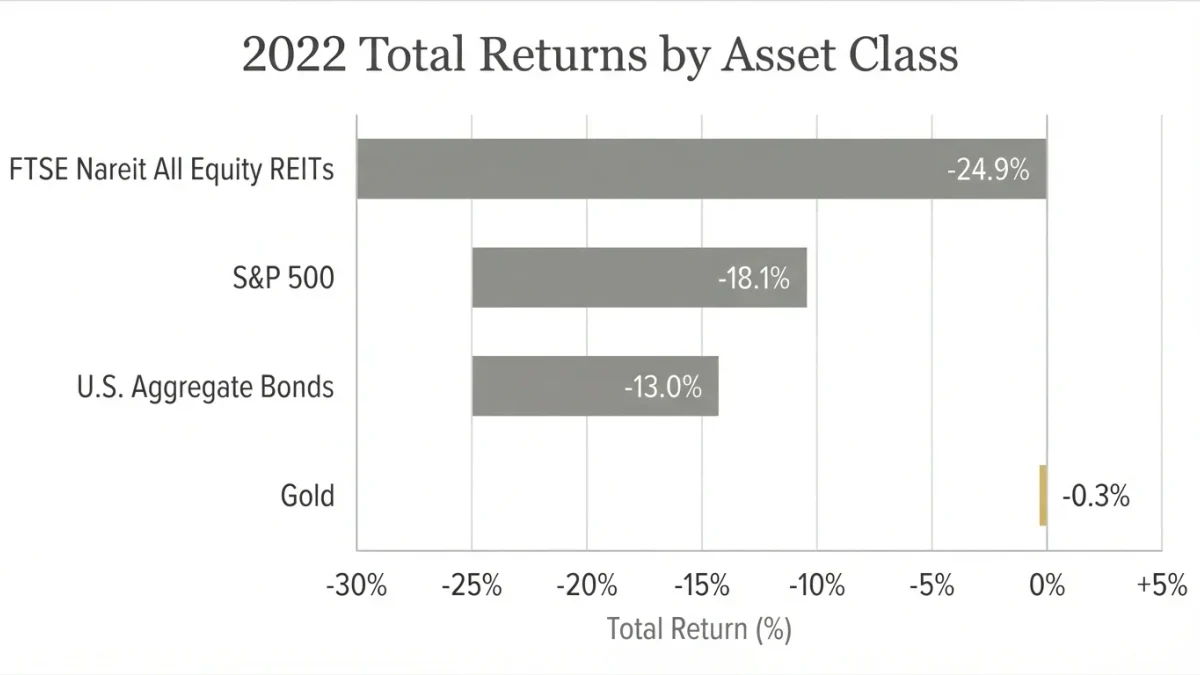
A conventional portfolio holds two main engines: stocks, which pay for growth, and bonds, which pay a fixed stream and cushion downturns. Both engines share a weakness. In a period of high inflation, stocks can fall as profit margins compress and interest rates rise, and bonds fall at the same time because rising rates cut the value of existing fixed payments. A sleeve that tends to hold value or rise when inflation drives rates up addresses that shared weakness directly.
That is the test every alternative sleeve should pass: it must add something the core mix lacks, not just another way to own the same risk. An asset that rises and falls with corporate profits, however exotic its label, is not diversifying a stock-heavy portfolio. This is the same concentration question examined in Diversification Explained: Why Concentration Is the Hidden Risk — owning more things is not the same as owning different risks.
How does gold behave, and what is it for?
Gold produces no cash flow. It pays no dividend, no interest, and no rent. Its value in a portfolio comes from two properties: scarcity that no issuer can dilute, and a long cultural record of being accepted in exchange. Because no company's earnings or any government's solvency stands behind it, its price is driven by demand for those properties, not by business conditions.
The practical consequence is that gold's price responds most strongly to things that erode confidence in paper claims: high inflation, currency debasement, and financial stress. That makes it a hedge against a specific set of failures rather than a growth asset. The trade-off is equally plain. Over long stretches in which none of those failures occur, gold can go long periods without gains while stocks compound earnings — a cost of insurance that sits idle. A gold sleeve is therefore sized for the failure it insures against, not for expected return.
What do REITs add, and what risk do they carry?
A REIT is a company that owns income-producing property and, by the rules that govern the structure, passes most of its rental income to shareholders. The mechanism is direct: the investor owns a claim on rents. Rents are a real-world cash flow that can adjust with inflation, which is the property that makes real assets attractive when inflation erodes the fixed payments of bonds.
But a REIT is still a company, traded like a stock, financed with debt. In a broad market selloff, REIT prices have historically moved with equities rather than against them, because the same fear that sells stocks sells anything traded on an exchange. The diversification benefit is real but conditional: REITs add a different source of cash flow, not immunity from equity risk. They also add interest-rate sensitivity, since property values and borrowing costs move against each other. A REIT sleeve diversifies the income base of a portfolio; it does not diversify away the stock market.
Do commodities earn a place, and at what cost?
Commodities — energy, metals, agricultural goods — are the most direct inflation exposure available. When the price of fuel or grain rises, the commodity position rises with it, which is exactly the event that hurts stocks and bonds. The mechanism is clean: the investor owns the input cost that is driving everyone else's problems.
The costs are equally direct. Commodity futures must be rolled — expiring contracts replaced with later ones — and that rolling process can lose money when near-term prices exceed later ones. There is no yield, so the position produces nothing while it waits. And commodity prices are set by supply and demand for physical goods, which can swing hard in both directions on weather, politics, and production decisions no investor controls. Among the three sleeves discussed here, commodities are the most volatile and the least forgiving of bad timing.
Our analysis: how the three sleeves rank for a mainstream portfolio
Ranked by the reliability of the diversification job each does, the case is clearest for REITs, conditional for gold, and narrowest for commodities.
- REITs add a distinct cash-flow stream — rents — that can be held through ordinary vehicles, with the caveat that they trade with the equity market. The benefit is a different income source, not different price behavior in a crash.
- Gold insures against inflation and confidence failures specifically. It earns a small sleeve when that failure mode matters to the holder, and costs performance when it does not.
- Commodities deliver the purest inflation response but carry rolling costs, no yield, and high volatility. The case is strongest for portfolios whose central concern is inflation erosion.
None of these sleeves changes the structural work of the portfolio. The target weights, the rebalancing method, and the question of where each asset sits for tax purposes remain the same decisions described in Strategic vs. Tactical Asset Allocation: How They Differ and Asset Location: Which Assets Go in Which Accounts. An alternative sleeve is an addition to that structure, not a replacement for it.
Where does crypto fit in this picture?
Crypto assets are sometimes grouped with alternatives because they share one property with gold: no issuer stands behind them. The differences matter more. Crypto prices have historically swung far more violently than gold or commodities, the market operates continuously with no closing bell, and custody — who actually holds the asset — is a live risk the holder must solve, as the coverage of crypto on this site repeatedly emphasizes. Crypto assets can lose most or all of their value quickly. Any sleeve of this kind carries that risk in full, and nothing in the diversification argument reduces it.
What should a reader take from this?
The evidence supports a modest conclusion. Alternative sleeves earn their place by doing a job the core mix cannot: gold addresses confidence and inflation risk, REITs add a rent-based income stream, commodities give the most direct inflation exposure at the highest cost in volatility. The right question for any sleeve is not whether it has performed well, but which portfolio failure it addresses and what it costs while that failure does not occur. That framing, applied consistently, is what separates a diversification decision from a performance chase — and it is the same discipline behind the broader frameworks collected under allocation.