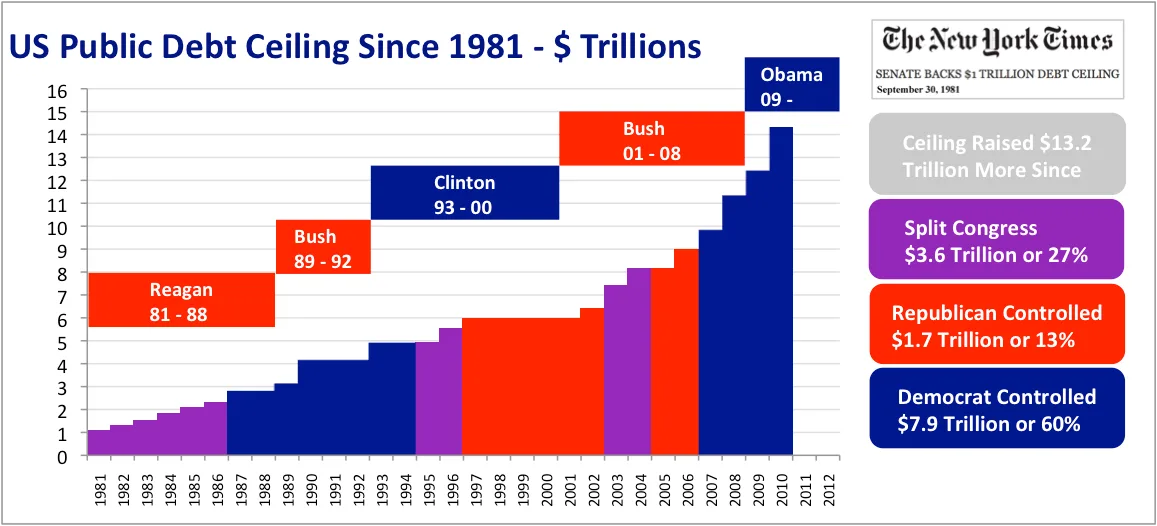

The debt ceiling is a statutory cap on the total amount of money the United States Department of the Treasury may borrow to finance obligations that Congress has already authorized. Congress has raised or suspended the limit close to 80 times since 1960, per the Congressional Research Service, and lifted it by $5 trillion to $41.1 trillion in July 2025.
Debt ceiling mechanics describe fiscal procedure rather than any recommendation about Treasury securities or other assets, and outcomes depend on decisions only Congress and the Treasury can make.
What is the debt ceiling, and where did it come from?
Congress first restricted Treasury borrowing with the Second Liberty Bond Act of 1917, which capped issuance of individual bond series during World War I. An aggregate limit on nearly all federal debt has existed since 1939. The modern ceiling applies to debt issued to fund spending and tax laws that have already been enacted, which is why raising it does not, by itself, authorize new spending.
Debt subject to the limit includes marketable securities such as bills, notes, and bonds, plus intragovernmental holdings such as trust fund accounting balances. Because spending and tax law determine deficits independently of the ceiling, the limit has been adjusted repeatedly as accumulated borrowing catches up to it, per the Congressional Research Service.
What happens when Treasury reaches the debt ceiling?
Once outstanding debt reaches the statutory cap, the Treasury cannot issue new net debt. The department then turns to extraordinary measures, a documented set of accounting tools that temporarily create room under the limit. Per Treasury descriptions, these measures include suspending sales of State and Local Government Series securities, redeeming existing investments and suspending new ones in the Civil Service Retirement and Disability Fund, and suspending investment of the G Fund of the federal retirement Thrift Savings Plan.
These actions do not cut spending; they defer internal transactions that would otherwise count against the ceiling. The Treasury formally declares a debt issuance suspension period in a letter to Congress, as it did on January 21, 2025, when the reinstated limit was reached shortly after the Fiscal Responsibility Act's suspension expired.
What is the X-date?
The X-date is the projected day on which extraordinary measures and the Treasury's cash on hand would both be exhausted if the limit were not changed. The term is used by the Congressional Budget Office and the Bipartisan Policy Center in their projections of how long the measures can last. Forecasting the date is imprecise, because daily revenue and outflow swings of billions of dollars move the estimate week to week.
After an X-date, the Treasury could spend only what arrives in daily revenue. Treasury officials have long stated that payment systems are not designed to prioritize some obligations over others, which is why analysts treat a lapse past the X-date as a potential default event rather than a managed delay.
What did major debt ceiling episodes look like?
| Year | Action | Documented outcome |
|---|---|---|
| 2011 | Budget Control Act raised the limit on August 2, 2011 | Standard and Poor's downgraded the U.S. rating to AA+ on August 5, 2011 |
| 2013 | Limit suspended in October 2013 after a standoff | Suspension expired February 2014 with a new limit set at prevailing debt |
| 2023 | Fiscal Responsibility Act signed June 3, 2023 | Limit suspended through January 1, 2025 |
| 2025 | Limit reinstated January 2, 2025; extraordinary measures from January 21 | One Big Beautiful Bill Act raised the limit by $5 trillion to $41.1 trillion on July 4, 2025 |
How does the debt ceiling differ from a government shutdown?
A government shutdown occurs when annual appropriations lapse, idling agency functions that depend on new spending authority. The debt ceiling concerns the opposite end of the transaction: paying bills for spending that Congress already enacted. The two can bind at the same time or independently, and neither automatically triggers the other.
The fall 2025 lapse in appropriations, which delayed federal economic statistics for weeks, illustrates the distinction. That episode curbed agency operations, while the debt ceiling itself, raised months earlier in July 2025, played no role in it.
Why do markets watch the debt ceiling?
Two documented channels matter. First, yields on Treasury bills maturing near a projected X-date have tended to rise in past episodes, because some investors avoid maturities that could carry missed-payment risk. Second, the 2011 episode ended with the first downgrade of the U.S. sovereign rating in history, an event tied in public commentary to the standoff rather than to underlying payment capacity.
Rating agencies have pointed at these standoffs. Fitch Ratings lowered the U.S. rating to AA+ in August 2023, citing governance and repeated debt limit brinkmanship among its stated reasons, and Moody's moved the United States from Aaa to Aa1 in May 2025 in a decision that referenced rising deficits. Neither action changed the Treasury's ability to pay; both cited the fiscal process around it.
The ceiling is a recurring institutional feature rather than a one-time crisis. Debt held by the public stood near $30 trillion when the July 2025 increase was enacted, per the Bipartisan Policy Center's summary, so the space created by the $5 trillion increase frames how far away the next binding date sits.