
Proof of stake is a consensus mechanism that secures a blockchain by requiring participants to lock up coins as collateral, with the network choosing among these validators to propose new blocks. When Ethereum switched to proof of stake on September 15, 2022, its energy use fell by about 99.95 percent, per Ethereum Foundation figures reported by the BBC.
Crypto assets receive the same discipline as every other asset class on this site: the same sourcing bar, the same risk framing, and no separate vocabulary. Crypto assets can lose most or all of their value quickly, and nothing about the underlying mechanism changes that.
What Problem Does a Consensus Mechanism Solve?
A consensus mechanism is the rule set a distributed network uses to agree on one shared transaction history without a central referee. Open, permissionless networks have no bank or clearinghouse to settle disputes, so the rules themselves must make falsifying the ledger prohibitively expensive. Proof of stake prices dishonesty in the network's own currency: a validator that signs conflicting histories risks part or all of the coins it deposited. The mechanism is an economic security system first and a technical one second.
The design question is old in distributed computing, but public blockchains sharpened it. Anyone can join, anyone can send messages, and some participants are assumed to be adversarial. Classical consensus research from the 1980s and 1990s assumed a known, fixed membership, which open networks cannot. Proof of stake, like proof of work before it, extends those ideas to open membership by attaching a cost to participation and misbehavior alike.
How Are Validators Chosen and Rewarded?
Validators are chosen by protocol rules that weigh each participant's deposited stake, with randomness preventing anyone from predicting or buying the next slot in advance. In exchange for proposing blocks and attesting to others' work, validators earn rewards denominated in the network's native asset. Misbehavior triggers penalties that scale with severity. The general flow on Ethereum looks like this:
- Deposit. A participant sends 32 ETH to the staking contract to activate one validator, or joins a pooled service.
- Attest. Each validator votes on blocks every epoch of 6.4 minutes; the protocol rotates duties automatically.
- Propose. One validator is selected per 12-second slot to build the next block, with selection odds proportional to stake.
- Earn or pay. Honest, online validators accumulate rewards; offline validators bleed small penalties; provable attacks trigger slashing.
Slashing is the mechanism's enforcement arm. Validators that sign two conflicting blocks at the same height, or surround earlier blocks to rewrite history, lose a portion of their stake, and large coordinated violations can consume the entire deposit while ejecting the offender from the validator set. Enforcement is automatic because the offending signatures are themselves the evidence; no court or administrator is involved.
What Does It Cost to Run a Validator?
On Ethereum, one validator requires a 32 ETH deposit and a machine that stays online, typically a modest server rather than specialized mining hardware. Staked coins became withdrawable in April 2023, when the Shapella upgrade opened exit queues that had been closed since the deposit contract launched in 2020. As of December 2025, roughly 35 million ETH, about 28 percent of all ether, was locked in the staking contract, per Beaconcha.in network data. Smaller holders participate through pools that aggregate deposits below the 32 ETH threshold.
Those alternatives carry their own tradeoffs. Liquid staking services issue transferable receipts for staked coins, usable elsewhere in decentralized finance, but they concentrate large amounts of stake with a few protocols, a governance concern documented in on-chain data throughout 2023-2025. Delegated staking on networks such as Cardano and Solana assigns voting power to operators without transferring coin ownership. Exchange staking moves the operational burden to a platform, reintroducing a custodial intermediary in the process.
How Do Staking Rewards Work?
Staking rewards are protocol payments for validation work, funded by new issuance and, on some networks, a share of transaction fees. They are not interest, and the staked asset's market price can fall faster than rewards accrue. Between 2023 and 2025, solo Ethereum validators earned roughly 3 to 4 percent annualized in ETH terms, per Beaconcha.in data, before any service fees. Other networks run different parameters, with higher gross issuance and different inflation profiles.
Two structural details matter for Ethereum specifically. Since the 2021 EIP-1559 upgrade, a base portion of every transaction fee is burned, which at times has offset new issuance entirely, leaving net supply growth roughly flat in high-activity periods. And since the September 2022 Merge removed mining, staking rewards are the network's only source of new supply, a documented design change rather than a market outcome.
How Does Proof of Stake Compare With Proof of Work on Energy?
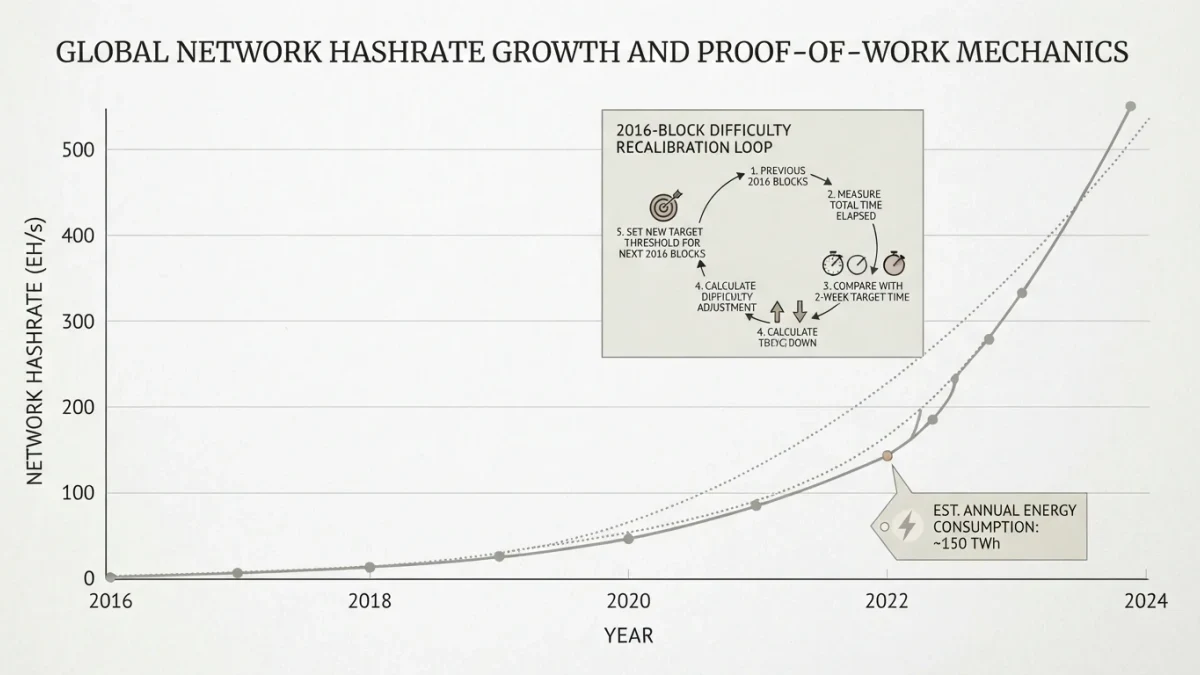
The energy contrast is the most documented difference between the two mechanisms. A September 2022 White House Office of Science and Technology Policy report estimated that crypto assets consumed 120 to 240 terawatt-hours of electricity per year in 2021, or 0.4 to 0.9 percent of global electricity, with proof-of-work mining the dominant share. Proof-of-stake networks replace that machinery with ordinary servers. The BBC's coverage at the time of Ethereum's transition recorded the foundation's estimate that the switch cut the network's energy use by about 99.95 percent.
The comparison needs two qualifications. First, lower energy use is a property of the mechanism, not a verdict on any network's security; the security models differ, as the table below summarizes. Second, energy figures for proof of work are estimates with methodological debates attached, which is why this article cites a government report and contemporaneous reporting rather than single-source dashboards.
| Dimension | Proof of work | Proof of stake |
|---|---|---|
| Security budget | Electricity and hardware spent continuously | Capital locked in deposits, at risk of slashing |
| Entry cost | Specialized mining hardware | Native coins (32 ETH solo on Ethereum) |
| Energy profile | High; OSTP estimated 120-240 TWh/yr for crypto in 2021 | Low; ordinary servers |
| Documented criticisms | Energy use, e-waste, mining concentration | Stake concentration, compounding advantage for large holders |
What Are the Documented Criticisms of Proof of Stake?
Criticism falls into three documented groups. Concentration: liquid staking pools and large exchanges control a significant share of staked ether, which critics argue shifts governance power toward a few operators. Compounding: rewards accrue in proportion to holdings, an advantage larger participants can compound automatically. Bootstrapping: proof of stake presumes a valuable native asset from day one, and new networks must distribute that asset somehow, typically through an initial allocation that itself concentrates holdings.
Older technical objections include the nothing-at-stake problem, in which validators costlessly sign multiple competing chains, and long-range attacks, in which retired validators attempt to rewrite history from a point where they controlled a large stake. Ethereum's design answers these with slashing and checkpointing, and it requires clients to trust recent finalized blocks, a property Vitalik Buterin's 2014 proof-of-stake FAQ called weak subjectivity. These are design answers rather than eliminations; the debates remain open in protocol research.
What Does the Mechanism Mean for How an Asset Is Evaluated?
A consensus mechanism describes how a network resists tampering; it does not establish that the network's asset fits any particular portfolio. Staking yields compensate for operational and market risk, not a risk-free rate, because the staked asset can depreciate while rewards accrue. The evaluation questions remain the ones this site applies everywhere: what the asset is, what drives its value, how volatile it has been, and what individual circumstances permit. Mechanism literacy is a prerequisite for those questions, not a substitute for them.