A coin is the native asset of its own blockchain, issued and secured by that chain's protocol, while a token is an asset issued on top of an existing chain through programmatic rules. The ERC-20 standard, proposed for Ethereum in November 2015, underpins tokens including USD Coin, whose circulation reached roughly $60 billion by mid-2025 (Circle attestations).
Horison publishes information, not investment advice, and terminology alone establishes nothing about an asset's merit or fit, which depends on individual circumstances this site cannot know. The distinction matters for understanding what an asset is and where its risks sit. Crypto assets can lose most or all of their value quickly, coins and tokens alike.
What Makes an Asset a Coin?
A coin belongs to its own base layer. Bitcoin's BTC is created and secured by bitcoin's proof-of-work protocol; ether is issued to validators under Ethereum's proof-of-stake rules; solana's SOL plays the same role on its chain. In each case the asset is defined by the protocol itself, with no separate issuer, contract, or deployer behind it. Its supply schedule, issuance recipient, and security model are properties of the network's consensus rules.
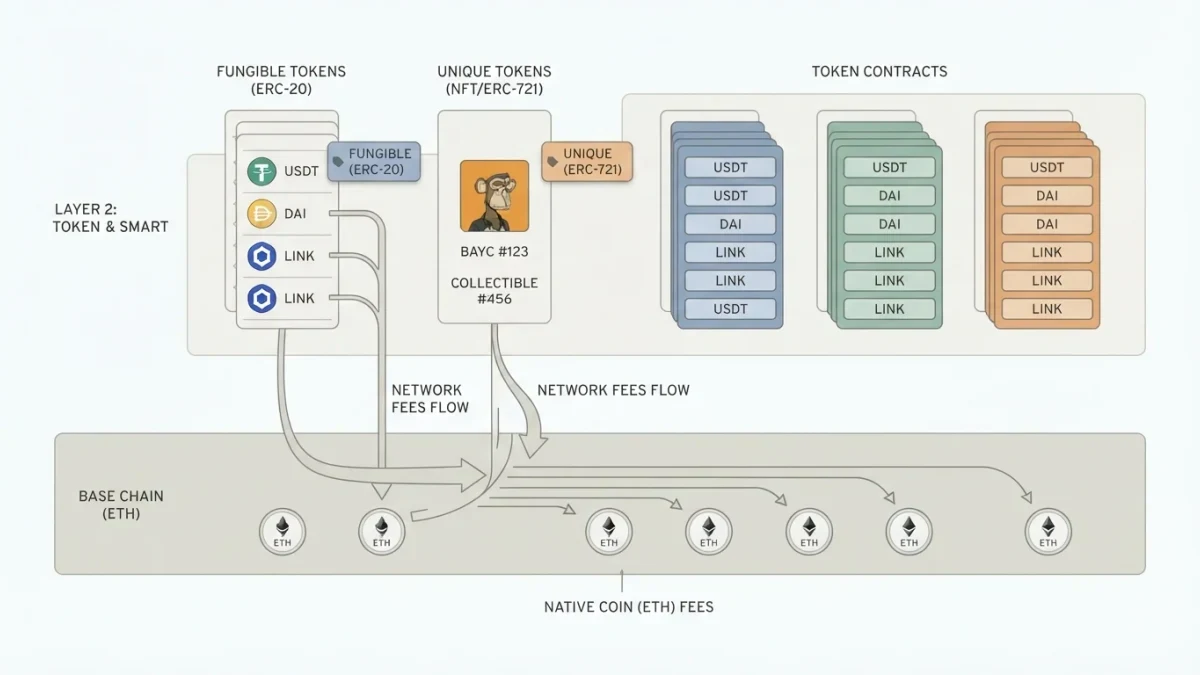
The defining function of a coin is fee payment. Every transaction on a smart-contract chain consumes computational resources, and the network charges for them in its native asset, conventionally called gas. This creates a built-in demand source tokens never have: activity on the chain, whatever tokens that activity involves, is paid for in the coin. The coin is also typically the asset staked or burned to secure the network, tying it to the chain's operation at the protocol level.
What Makes an Asset a Token?
A token is a balance recorded in a smart contract on someone else's chain. The contract defines supply rules, transfer conditions, and any special behavior, and the chain's validators process those transfers like any other computation. The token inherits the host chain's settlement and security but exists entirely as contract state: if the contract halts, freezes, or contains a flaw, the token's function halts with it. Ethereum hosts the largest token ecosystem, and equivalent patterns exist on Solana, Avalanche, and other programmable chains.
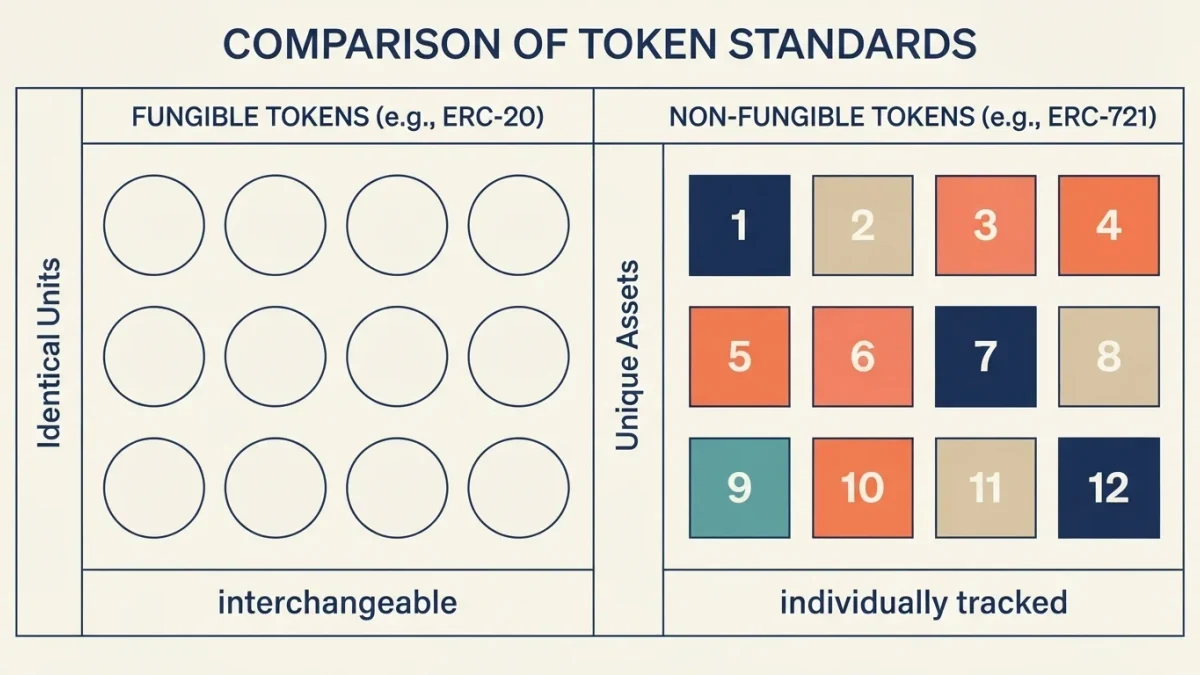
Standards make the category usable. The ERC-20 proposal of November 2015, authored by Fabian Vogelsteller and Vitalik Buterin, defined a common interface for fungible tokens, so that wallets, exchanges, and other contracts could support any compliant token without bespoke integration. ERC-721 (2018) standardized unique, non-fungible tokens, and ERC-1155 standardized contracts managing many token types at once. Familiar assets across this spectrum include USD Coin, Chainlink's LINK, Uniswap's UNI, and collectible tokens on the 721 pattern.
How Do the Fee-Payment Roles Differ in Practice?
The fee rule produces a practical asymmetry that confuses many first-time users: holding a token does not enable moving it. An address holding only USD Coin on Ethereum cannot transfer that token, because the transfer requires a gas fee paid in ether. The same applies to SOL on Solana and the native assets of other chains. Tokens are cargo; the coin is fuel, and both must be present for anything to move.
Some architectures soften the seam without removing it. Ethereum's account-abstraction standard, ERC-4337, introduced paymaster contracts that can let a third party cover gas in the native asset, and some wallets batch or sponsor small transfers. Underneath every variant, settlement still occurs in the chain's coin. The distinction between the asset being moved and the asset paying for the move survives all of the packaging.
What Are Wrapped Assets and Why Do They Exist?
Wrapped assets are the border crossing between the two categories: a coin reissued as a token on another chain. Wrapped bitcoin, launched on Ethereum in 2019, holds bitcoin with custodians and issues a corresponding ERC-20 token usable in Ethereum's contract ecosystem, and wrapped ether serves a similar plumbing role within Ethereum itself. The wrapper extends the asset's reach at the cost of an added trust or verification layer on top of the host chain's own security.
That added layer has a documented loss record. The Ronin bridge exploit of March 2022 removed about $625 million, and the Wormhole exploit of February 2022 removed about $325 million, in both cases from the bridge mechanisms that move or lock assets between chains, not from the base chains' consensus. A wrapped asset's risk stack therefore runs: the host chain, the bridge or custodian, and the original asset, each layer with its own failure modes.
Where Do Standards Come From and Why Do They Matter?
Token standards emerge from public proposal processes, Ethereum Improvement Proposals chief among them, where authors draft interfaces, developers implement and debate them, and wallets and infrastructure adopt the survivors. ERC-20's history illustrates the value: a common interface released before the 2017 token wave meant thousands of issuers could launch interoperable assets, and wallets could support all of them at once. Standardization is why the token category composes: a lending contract, an exchange, and a wallet can each handle any compliant token without knowing the issuer.
The same composability concentrates operational detail in the contract itself. Tokens can carry freeze functions, as USD Coin's issuer uses for compliance purposes, minting authorities, upgradeable logic, or transfer taxes, all visible in code but consequential for holders. A coin's rules change only through the base chain's own upgrade process; a token's can differ from its neighbor on the same block. Reading the contract, or a competent description of it, is part of understanding the asset.
What Practical and Legal Distinctions Have Been Documented?
| Dimension | Coin | Token |
|---|---|---|
| Issuance | Protocol-defined mining or staking rewards | Smart contract deployed by an issuer |
| Security | Base chain consensus | Inherits host chain; adds contract risk |
| Fee role | Pays the chain's gas | Cannot pay gas on its host chain |
| Behavior | Uniform across the network | Can freeze, mint, upgrade, or tax by code |
| Examples | BTC, ETH, SOL | USDC, LINK, UNI, ERC-721 collectibles |
Regulatory treatment has followed function rather than category. U.S. enforcement actions and court rulings during the 2020s addressed tokens case by case, including a July 2023 partial ruling in SEC v. Ripple that drew distinctions among types of sales; whether any specific asset is a security remains a legal determination that courts and agencies make, and this site does not resolve legal questions. For readers, the operative point is narrower: the coin-versus-token line is architectural, and it organizes how an asset works, not how it is judged.
The architectural line still carries practical weight in the ways documented above: dependency stacks, fee obligations, bridge risk, and contract behavior. Those are the questions this site applies to any crypto asset, alongside the market questions common to all of them. Whatever the category, the volatility disclosure is unchanged: crypto assets can lose most or all of their value quickly.