Proof of work is a consensus mechanism in which miners race to solve a computational puzzle, with the winner earning the right to append the next block and its reward. Bitcoin has run on the design since January 2009, and its network expends roughly 150 terawatt-hours per year, within Cambridge Centre for Alternative Finance estimates (2024).
This article explains a mechanism, not an investment case, and mechanism strength is not a measure of asset merit. Crypto assets can lose most or all of their value quickly, regardless of how the underlying network achieves security.
What Problem Does Proof of Work Solve?
Proof of work solves the double-spend problem for a network with no central ledger keeper: it makes participants agree on one transaction history by making the history itself the most expensive thing to fake. Miners commit irreversible computation to extend the chain, and the network accepts the chain with the most accumulated work. Rewriting the past therefore requires out-spending every honest miner across the entire span being rewritten. Security and expenditure are the same quantity viewed from two sides.
The design came from bitcoin's founding paper, published October 31, 2008, which combined earlier ideas, including proof-of-work spam protection from the 1990s and hash-chained timestamps, into what its author called a system for electronic cash without trusted parties. Verification stays cheap even though production is expensive: any ordinary computer can check a block's validity in seconds, while producing one competitively requires industrial hardware. That asymmetry, expensive to write and cheap to verify, is the mechanism's core property.
How Does the Mining Puzzle Work?
The puzzle is a brute-force search over a hash function's output. Bitcoin uses SHA-256: miners take a candidate block's contents, add a random number called a nonce, and hash the result, hoping the digest falls below a target value set by the protocol. There is no shortcut, only trial and error at billions of attempts per second per machine. The first miner to find a valid digest broadcasts the block and collects the reward.
- Assemble. Software collects pending transactions, prioritized by the fees attached to them, into a candidate block.
- Search. Mining hardware hashes the candidate with billions of nonce values per second, seeking a digest below the target.
- Broadcast. The winner publishes the block; every node independently re-verifies the single winning hash in a fraction of a second.
- Repeat. Other miners extend the new block, and the cycle continues roughly every ten minutes on bitcoin.
Because the winning solution is verifiable instantly and impossible to find on purpose, the puzzle functions as an unforgeable record of expenditure. A miner cannot pre-compute an advantage, borrow one from another chain, or fake the work after the fact. The block reward pays for this expenditure: new coins issued by the protocol plus all transaction fees in the block.
What Are Difficulty and Hashrate?
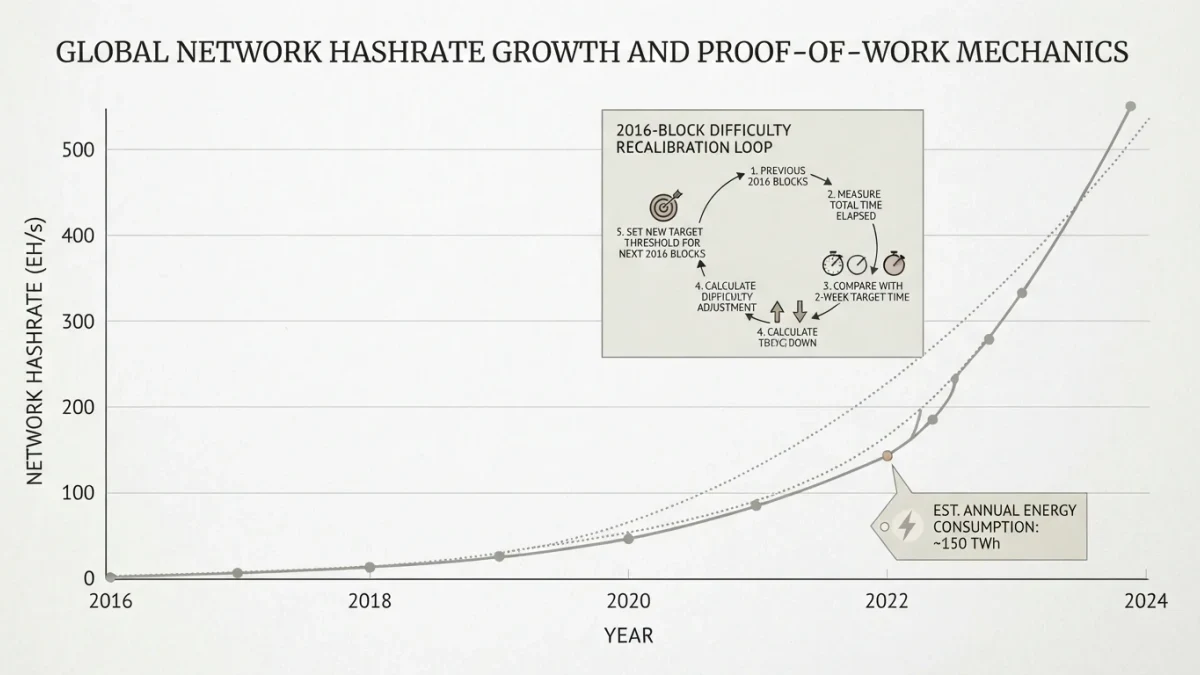
Difficulty is the protocol's automatic tuning of the puzzle, and hashrate is the total rate at which the network guesses. Bitcoin recalibrates difficulty every 2016 blocks, about two weeks, raising it when blocks arrived early and lowering it when they arrived late, which holds the average interval near ten minutes regardless of how much mining power joins or leaves. The mechanism is why bitcoin's block cadence has stayed stable through a hashrate increase of many orders of magnitude.
The hashrate record documents the industry's growth. Bitcoin's network ran in the tens of exahashes per second in the late 2010s, crossed a hundred exahashes in 2019, and operated in the hundreds of exahashes through 2024-2025, per Cambridge Centre for Alternative Finance data. Each upward step reflected better hardware generations, from general processors to graphics cards to today's application-specific integrated circuits, which can do nothing except hash. Mining pools aggregate this hardware so that individual participants receive steady fractional rewards instead of rare jackpot blocks.
What Is the Security Budget?
The security budget is the flow of value paying miners to secure the chain, and it equals the block subsidy plus transaction fees. Bitcoin's subsidy halves on a fixed schedule: from 50 BTC at launch to 25, then 12.5, then 6.25, and to 3.125 BTC per block after the April 2024 halving. As the subsidy declines toward zero over coming decades, transaction fees must eventually carry the budget, an open research question documented in protocol literature as the security-budget problem.
The fee side of the budget has been lumpy rather than smooth. Demand spikes, including the inscription-driven congestion of late 2023, at times pushed fee income to multiples of the subsidy for short stretches, while quiet periods left fees near zero. Because the security budget funds the expenditure that makes rewriting expensive, its long-run composition is a property of the mechanism, not a market detail, and researchers disagree in documented terms about how the transition resolves.
How Much Energy Does Proof of Work Use?
Energy use is the most documented and most disputed property of the mechanism. The White House Office of Science and Technology Policy estimated in September 2022 that crypto assets consumed 120 to 240 terawatt-hours in 2021, 0.4 to 0.9 percent of global electricity, with proof-of-work mining the dominant share. The Cambridge index's central estimates have run in the same range, around 150 terawatt-hours per year in its 2024 estimates. Both sources publish ranges, because measuring a distributed industry has methodological limits.
Emissions analysis is younger and rougher. A 2018 comment in Nature Climate Change projected that bitcoin emissions alone could push global warming above two degrees if adoption grew at tech-industry rates; the projection attracted substantial methodological criticism and assumed exponential usage growth that did not materialize on that path. Subsequent peer-reviewed work narrowed the estimates, and electricity mix, from flared gas to hydro to grid power, emerged as the dominant variable. The settled facts are the consumption figures; the interpretation remains contested.
What Are the Documented Strengths and Criticisms?
| Claim | Documented basis | Documented counterpoint |
|---|---|---|
| Battle-tested security | Bitcoin's ledger has never been rewritten since 2009 | Smaller proof-of-work chains have been attacked repeatedly |
| Permissionless participation | Anyone can mine or verify without approval | Hardware economics concentrate production in industrial pools |
| Objective verification | Validity checks require no trust in any party | Finality is probabilistic; deep reorganizations remain theoretically possible |
| Energy expenditure | 120-240 TWh/yr (OSTP, 2021 figure) | Emissions depend on electricity mix; e-waste from hardware turnover |
Smaller proof-of-work networks illustrate what the security budget buys. Ethereum Classic, which retains a proof-of-work design, suffered repeated 51 percent attacks in January 2019 and August 2020, in which renters of majority hashrate reorganized the chain and double-spent exchange deposits. The attacks documented the mechanism's scale requirement: proof of work secures a chain in proportion to what attackers must spend, and a small budget buys little.
How Does Proof of Work Compare With Proof of Stake?
The two mechanisms price the same thing, the right to write history, in different currencies: proof of work prices it in energy and hardware burned continuously, while proof of stake prices it in capital locked and subject to penalty. Proof of work's documented advantages are its long unbroken record and its independence from any native-asset valuation. Proof of stake's documented advantage is energy use lower by orders of magnitude. Neither mechanism settles the portfolio question, which rests on the asset's risk and the reader's circumstances, not on the consensus layer.